


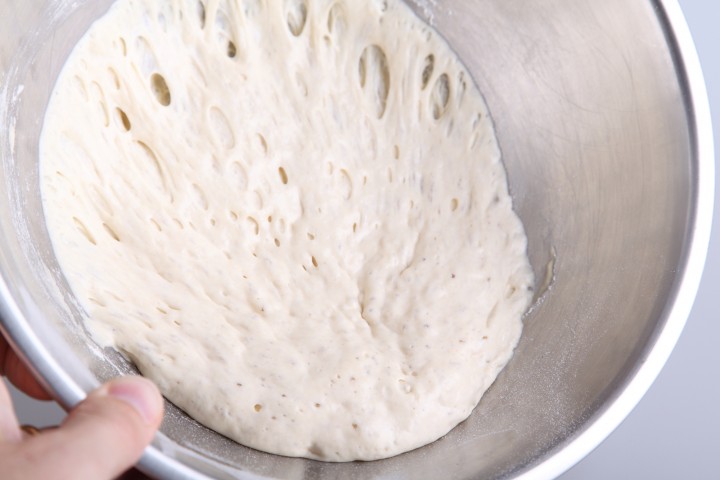
What is it?
There are several traditional methods for creating starters for breads. All of these starters are easy to prepare.
A starter usually consists of a simple mixture of wheat flour, water, and a leavening agent (typically yeast or a sourdough culture). After mixing it is allowed to ferment for a period of time, and then is added to bread dough as a substitute for, or in addition to more yeast. So pre-ferments are critical for best tasting bread – You can call it a starter, biga, poolish, preferment, or sponge – they all do sort of the same job and only really differ by water content.
Biga and poolish are terms for pre-ferments used in Italian and French baking, respectively, for sponges made with domestic baker’s yeast. Poolish is a fairly wet sponge (typically made with a one-part-flour-to-one-part-water ratio by weight), while biga is usually drier. Bigas can be held longer at their peak than wetter sponges, while a poolish is one known technique to increase a dough’s extensibility.
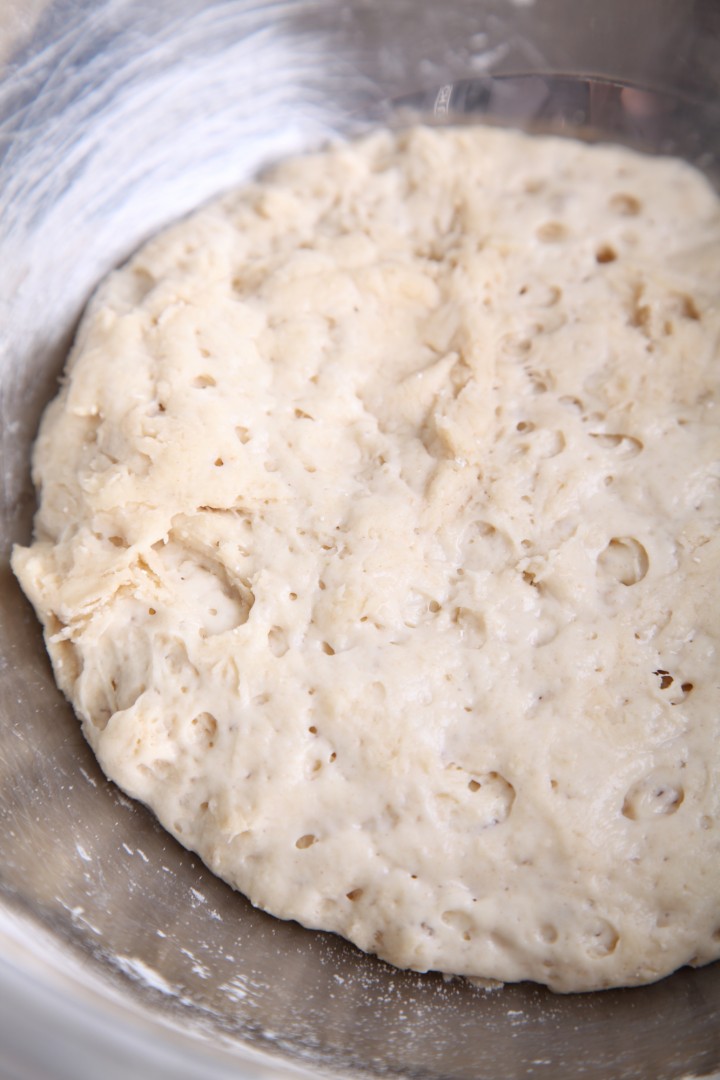
Why use it?
The primary difference between making bread with a starter and making bread with the direct or straight yeast method is that starter breads require much more time to prepare, but the flavor and texture of the bread is almost impossible to achieve with other leavening methods. Bread made with starters like poolish and biga also tends to keep better, compared to bread made from straight doughs.
Poolish & biga tips
- If you are working with pre-fermented doughs like poolish or biga make sure not to ‘over ripe’ your pre-ferment. This is especially true when using larger percentages of preferment in your final dough (think up to 50%) because over riping will kill the gluten in your preferment (the yeast will eat them all) and you will end up with a weaker and hard to handle dough.
- The higher the percentage of pre-ferment you use the more your bread crumb will have a nice chewy texture (but it stops at around 50%). We like our bread that way, it gives you something to chew on. The sugars that are released from the flour in the pre-ferment also add a nice golden colour to your bread.
- Yes you can make the same bread recipe using a biga or a poolish, you just need to make sure you adjust the water content.
- You can make a poolish or biga from another type of flour than the one you are using for the actual bread. For example, we use spelt, rye or whole wheat flour to add extra (and different) flavours to our bread.
Percentage of instant dry yeast in poolish
You can prepare your poolish up to 8 hours but also up to 16 hours in advance. But you have to adjust the amount of instant dry yeast you use. Logically, the more time a pre-ferment gets, the less yeast you have to use.
This is the schedule we use
Poolish up to 8 hours in advance – 0.23% – 0.33%
Poolish up to 12 hours in advance – 0.1% – 0.2%
Poolish up to 16 hours in advance – 0.03% – 0.08%
Example – How to calculate the right amount of yeast
You make a poolish consisting of 200 g flour and 200 g water. You make it 12 hours in advance (typically the night before the morning of baking) and it is summer or a nice warm room temperature for the poolish to ferment in.
You calculate the amount of instant yeast needed as follows:
amount-of-instant-yeast = amount-of-flour / 100 x percentage-of-table
For example;
200 g (amount of flour)
0.1% (yeast amount used in summer for 12 hour poolish)
To calculate 1% of 200g of flour you divide 200 g by 100 and multiply by amount in the table;
200 / 100 x 0.1 = 0.2 g instant yeast
(for fresh yeast multiply the amount by 3)
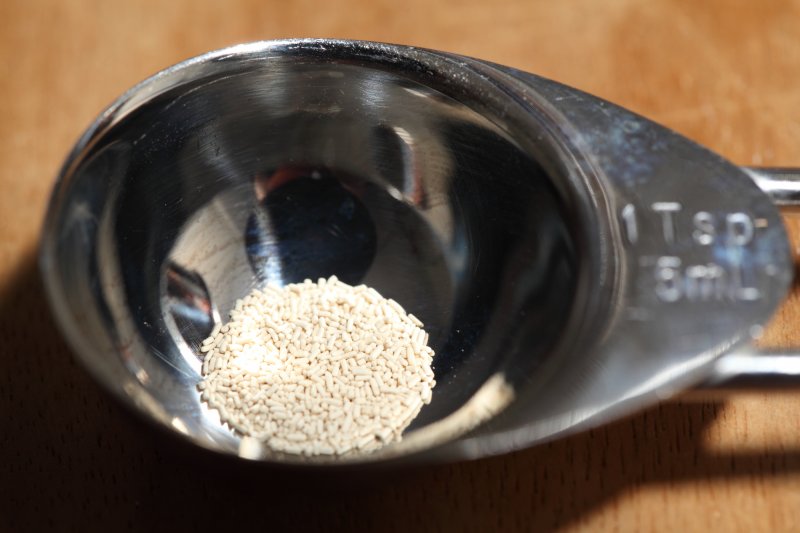
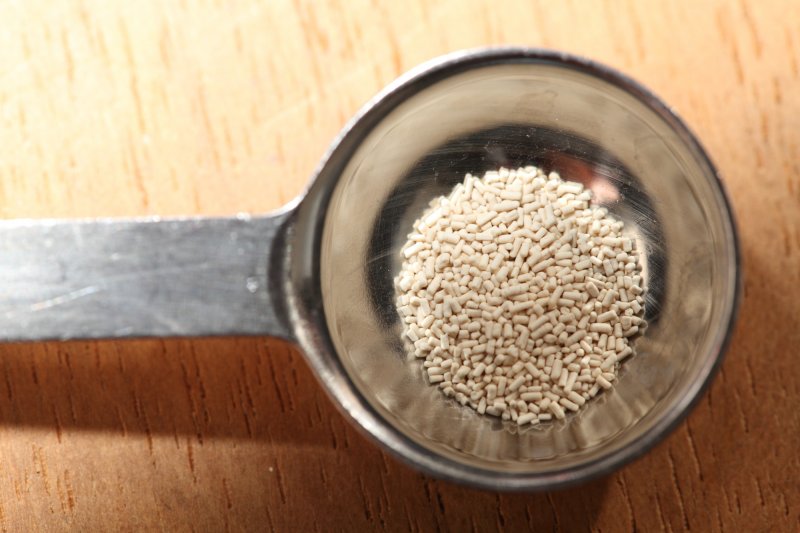
What does 0.1 gram of yeast look like?
To give you an idea of how tiny the amount of 0.1 gram of instant dry yeast is we have made some pictures. The third picture shows 0.1 grams of yeast in a teaspoon, the last picture shows 0.1 grams of yeast in a 1/4 teaspoon.
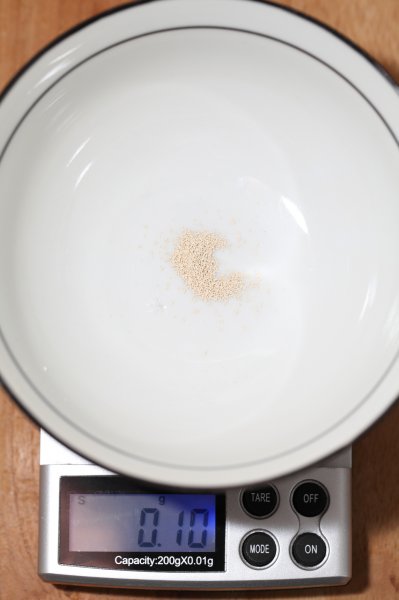
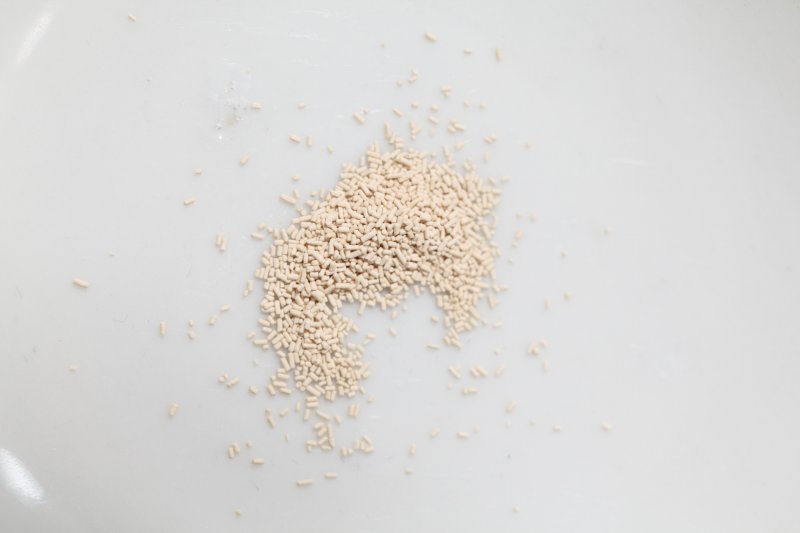
To give you an idea of how much instant dry yeast goes into a measuring teaspoon:
1 tsp dry yeast = 3.1 g
1/2 tsp dry yeast = 1.6 g
1/4 tsp dry yeast = 0.78 g
Also check out our recipe for pizza dough with a poolish
Find our favorite bread recipe with a sourdough culture based poolish here


Susan Smith says
Thank you for sharing your experience and knowledge. I am taking baby steps in my baking experience and appreciate the work that you’ve shared.
Weekend Bakers says
Thank you Susan,
Baby steps is exactly the pace we would advice. And enjoying the journey of course.
And in case you have not spotted them yet, these are our other general baking tips :
www.weekendbakery.com/posts…king-tips/
Happy baking!
Lucian says
Really great piece on poolish! For predictability’s sake I like to cold ferment the poolish in a fridge, our summers are hot and humid. What’s a good yeast percentage for cold fermenting 20-24 hours? Thank you.
Weekend Bakers says
Hello Lucian,
Thank you very much. A good indication would be between 0.5 (18 hours) and 0.3 percent (24 hours).
You can also check out our table percentage that we use for pizza, that is also a good starting point for your poolish.
See: www.weekendbakery.com/posts…gh-recipe/
Hope it will turn out great and your summer will be enjoyable and not too hot.
Greetings from Holland
Ken Nelson says
I HAVE A BREAD RECIPE AND WANT TO USE A POOLISH. DO I USE THE FLOUR FROM THE ORIGINAL RECIPE TO MAKE MY POOLISH.
LETS SAY MY ORIGINAL RECIPE CALLS FOR 3 CUPS OF FLOUR HOW MUCH FLOUR DO I REMOVE FROM THE ORIGINAL 3 CUPS OF FLOUR. WHATEVER THAT AMOUNT IS I MIX WITH EQUAL AMOUNT OF WATER. TO THIS MIXTURE HOW MUCH YEAST DO I ADD?
Weekend Bakers says
Hello Ken,
Yes, you can take an amount of flour from the original recipe. A good start for you would be to take one cup of flour and make the poolish with that.
To be honest we are not so ‘good’ with cups because it is not exact, but if one cup of flour is about 125 grams we suggest the following:
So for example if you make a poolish and want to leave it for 12 hours:
1 cup /125 g (amount of flour)
0.1% (yeast amount used in summer for 12 hour poolish)
To calculate 1% of 125g of flour you divide 125 g by 100 and multiply by amount in the table above;
125 / 100 x 0.1 = 0.125 g instant yeast
(for fresh yeast multiply the amount by 3)
If it is cold we would double this amount.
The amount is very, very small, so if you cannot weigh it on a precision scale, you need to guess(timate) the amount like we show in the pictures above.
Use a 1/4 teaspoon for this – which needs to be filled for about 1/4.
Just give it a try and keep an eye on the poolish to make sure it does not over-ripe. Underdevelopment is usually not a problem, because you can correct this in the final dough by a longer proofing period or the use of a bit of extra yeast.
Mohammadreza says
Hi
can we use instant dried yeast instead of Poolish and biga?
Weekend Bakers says
Yes, you can make a ‘straight’ dough with instant dry yeast, without first making a poolish or biga that is later used in the final dough. But this method of first making a preferment like a poolish or biga, delivers in general a much more interesting loaf with better taste and texture and which is also easier to digest.
A great recipe for a straight dough with instant dry yeast is this one:
www.weekendbakery.com/posts…wich-loaf/
Adarsh Avuku says
Hello there ,
I am trying to make poolish for 20 kg flour , how much amount of poolish I need and how much amount of yeast should I put . Help would be appreciated thank you so much
JR says
How fast would biga and or poolish ferment at 28-30C(my room temp)?
John fahy says
Might I suggest that, In order to accurately measure the small amounts of yeast. Mix a small amount of yeast that your scales can measure, say 3 g. With a known amount of measured flour I suggest 27g. Mix completely. When you are required to use .2 g of yeast. Measure 2g of the mixture. One part in 10 will be yeast. Store the rest in a sealed bottle in the fridge. Or throw, and start again next time if you do not think you will need to use the mixture again while it is still fresh.
TOGO says
DOUGH PROOFING STATION:
Place a large rectangular plastic (primary) container on a seed propagation mat. Next; -pour approximately 1-1/2″ deep (tap) hot water into the container. Finally; -place your dough in a secondary container, round or long bread pan, and place it into the primary container. You now have a temperature controlled environment for year round dough proofing
Jim says
What is the best temperature of room to ferment your poolish?
Keri says
Room temp is ideal for a pre-ferment (Poolish), same with most breads that are proofing 🙂 I hope that helps!
Joe says
Can a biga overferment? How do I know if my biga is ready to use?
Keri says
As the article mentions, biga is more forgiving than a poolish per-ferment, so it is harder to over-ferment, I would allow it about 16-24 hours. I hope that helps!
Carol McDonald says
Can you just make bread with mixing the flour and water and leave the dough sit for a couple of days to sour and attract wild yeast, then add normal dry yeast?
I don’t want to do the entire sour dough thing
john Ostrowski says
Yes, you can, but every day you need to remove some of the mixes and add equal amounts of water and flour each day for the next 7 days. It will continue to improve. After that, you can refrigerate and add ingredients once a week.
JD says
Hello, I am curious as to what “percentage-of-table” means when calculating the yeast. I am new to this as I plan to start making pizzas in my new pizza oven and that’s the only thing that stumps me. Is there table or graph to look at?
Thank you!
Romy says
They provide an equation just above to figure out quantity.
Ric Whiting says
I use an entirely different kind of measuring for the amount of yeast in my sponges. I take 1/4 cup of water, add 1/8th tsp yeast and stir until dissolved.
I then use ONLY 2 tsps. of the yeasted water in my sponge. Assuming I am making only one loaf of bread.
Poolish example:
34 gram W.W. flour
34 gram of unbleached bread flour
68 gram of water
2 tsp of the YEASTED WATER.
At normal kitchen temps, this is ripe at about 12 hours.
Gary says
Great idea! I like avoiding the need for another scale.
Drew458 says
Interesting. A standard measure of yeast is 2.5tsp which is 7gm. So that’s 0.7gm per 1/4tsp, or 0.35 per 1/8tsp. A tsp of water is a gnat’s hair under 5gm, so 1/8tsp water weighs 0.625gm. 100 of these add up to 62.5gm. Fully dissolve your 1/8tsp in that and you get 0.028gm yeast per teaspoon. Do the math to get the fractional amount of yeast you want; 4tsp gets you 0.112gm, just over 1/10gm of yeast.
Do we really need that level of precision?
Weekend Bakers says
As bakers, we do consider baking to be an exact science and as such we personally like the idea of measuring everything, even the tiny amounts. Using spoons means you can deviate up to 20% compared to using scales. If you want to be consistent in baking we have found we cannot do without our scales.
Richard Whiting says
I sure wish the author had told us how to know if the biga is “over-ripe”.
At least tell us how to know when the biga is perfectly ready.
deb says
I saw on a you tube video, that if the poolish has risen and then collapsed down, it’s over ripe. If it’s just starting to collapse, it’s ready. Some one also put a rubber band around the jar that the poolish was in to measure the starting height to the raised height. I think it was going for a doubling of the poolish. I sure hope not as my poolish was probably triple. Check out some videos on youtube. There are so many approaches that I got overloaded. But it may be helpful, in fact I know it will be.
Romy says
I did the same! I over-ripened my poolish. I used it anyway and no one died.😅
Jean Paul Reuland says
Very interesting job done!
My question is: can a long 24 hours Poolish in refrigerator equal effects on digestion like sourdough bread?
Thank you
Samantha says
Don’t be foolish, make a poolish
Chris Kassel says
I prefer a biga, amiga.
Mannie says
I once had a farm in Africa
Emily says
Hello, I was wondering if you know anything about the percentage of “hydration” when making a poolish? I’m wanting to make a focaccia and have heard “hydration” mentioned, like a 85% hydration. How is that measured? Thank you.
Christian van der Leeden says
I think hydration is the amount of water in regards to the total flour weight. 85% would be 85g of water for 100g of flour. AFAIK poolish is mostly water to flour (1:1). Since it is a starter dough you would adjust the water you add in the 2nd step (main dough) so that the total amount of water and the total amount of flour in the dough are then in the relationship that your hydration calls for.
Marilyn Katz says
what to do if you don’t have sourdough starter for your poolish?
Christian van der Leeden says
Well you could go to the supermarket
Mike says
The poolish is started with normal yeast.