


Rule of thumb for your baking: 1 gram baking powder to 25 grams of flour
Have you ever read the back of a packet of baking powder to check what is actually in it? Next to cornstarch and baking soda also referred to as E 500(ii) in Europe, you can find other raising agents. The one in a much used package in Europe was labelled E 450i. I looked it up in my E-numbers and additives book and I read that this ‘disodium diphosphate’ can have several side effects like slowing down your intake of calcium, hyper activeness in children and possible kidney damage. This for me was a first incentive to take a closer look at alternatives.
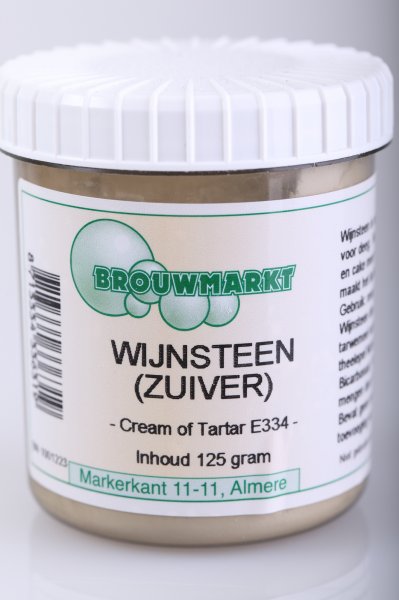
For many years I already used baking powder from the organic store, consisting of cream of tartar (an acid), baking soda (a base) and corn starch (a filler to absorb moisture). Then I got the idea of making it myself, just for the fun of it and also learn more about the how and why. I found a place where I could buy a larger quantity of cream of tartar (a kilo at brouwmarkt here in Holland), next to the bigger packages of organic cornstarch and baking soda that you can easily find anywhere. So now I can make baking powder and self raising flour with my favorite organic flour for many bakes and feel good about it. And I save some money in the process too…
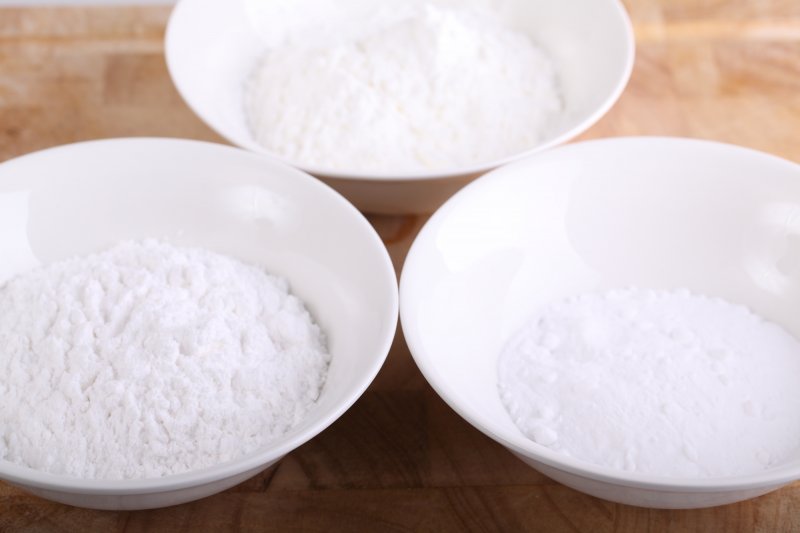
Making your own baking powder is easy and it has several advantages:
- You know what goes into it and avoid things like aluminum and genetically modified corn
- It is, so I found out, 30 to 50% cheaper than buying the commercial packages
- You won’t run out of baking powder that easily anymore
- You can make the right amount of powder in advance, according to your baking needs
- You use it with your favorite flour to make the best quality self raising flour
Ingredients for baking powder small batch
100 grams
50 g cream of tartar
23 g baking soda
27 g cornstarch
Ingredients for baking powder large batch
250 grams
125 g cream of tartar
56 g baking soda
69 g organic cornstarch
For people without scales: for 1 teaspoon of baking powder, mix 1/2 teaspoon cream of tartar with 1/4 teaspoon of baking soda and 1/4 teaspoon cornstarch.
How to use the baking powder
As a rule of thumb for your baking you add 1 gram baking powder to 25 grams of flour used.
You have to work quickly after stirring, because this baking powder is a so called single acting or fast acting powder.
Baking powder comes in two versions: single acting baking powder, like the one described above, contains acid that dissolves in water. The chemical reaction begins as soon as liquids are added. You have to work quickly to get the most out of this type of powder. I use it in cakes, muffins, scones and cookies and for me it works perfect.
The double acting baking powder, which is the more common commercial version, contains a second acid that only kicks in when it reaches a certain temperature in the oven. If you buy this variety, make sure you get the one that is aluminum free.
Many recipes call for baking soda rather than baking powder. Usually these recipes use some kind of liquid acid like buttermilk or yogurt to react with the baking soda to produce the bubbles.
More on this subject:
E-notes – How it works and history
Baking powder versus baking soda
Baking ingredient substitutions


Cecelia Tkach says
How can it be cheaper to make at home? It’s great to have the recipe for emergencies but not to make it all the time. An 8 ounce can of double baking powder is $1.98 while 1.5 ounces of Cream of Tartar is $2.99, corn starch (cheap) baking soda cheap as well but it’s the cream of tartar that makes this product expensive to make all the time. Thank you for recipe.
Weekend Bakers says
Thank you Cecelia,
We think it could also be different from one country to the next. For us this method is still very much cheaper but the main reason will always be to avoid the ingredients we do not want in our bakes.
Enjoy your baking 🙂
Albert Sidambe says
Hie, pliz help me with double acting baking powder recipe
Weekend Bakers says
Hello Albert,
Sorry, we do not have this, because the ingredients you need for it are not something we like to use and we are also not sure you could even buy them.
Pertunia Silempa says
how much of SAPP can i use for every 25 grams of flour
Weekend Bakers says
As a rule of thumb for your baking you add 1 gram baking powder to 25 grams of flour used.
Lucas Miller says
Hoi,
i work in an organic bakkery in Utrecht. we make a large volume of scones every morning.
They are lovely and fresh but the time it takes to make them every day considerable. I’ve looked into making enough for the whole week and freezing the raw dough. At the moment that isnt possible because, i think the bakpoeder we use is double acting, it reacts to quickly with the wet ingredients. the result is flat, lifeless scones. I was just wondering if you had any suggrstions, from what i understand i need to slow acting bakpoeder? one that reacts only when heat is introduced. Might that be the solution ?
Any advice would greatly be appreciated.
Thanks
Lucas
Weekend Bakers says
Hi Lucas,
We understand your problem in finding a solution for this. The baking powder we suggest here is single acting but not in the way you are looking for (it gives a chemical reaction and not the temperature reaction you need).
Maybe you could find some advice via this link: blog.kingarthurflour.com/2016/…ke-scones/
Hope you find the perfect way. Good luck with your bakery!
Ed & Marieke
fanuel chabikwa says
l like your advice towards baking
Weekend Bakers says
Glad you find it useful Fanuel.
Shazia Ansari says
Very good information. I googelled for a recipe and got to your website. The way you are explaining things is indeed helpful for people like me who have just started baking. I am throwing away all ready to use cake boxes and will rely on good informative website like yours. Many thanks for your input and ideas. Best Regards.
Weekend Bakers says
Thank you very much for your kind words Shazia!
Happy Baking,
Marieke
Sylvia Vervest says
Over the past year we have stopped useing as much processed stuff as we can (not that we used much before) and make as much of our food ourselves. At first I thought why would I make my own baking powder, then I read the piece above and now I know why. You just don’t think that someting so innocuous as Baking Powder would have anything but the basic stuff needed to do the job of a raising agent and I must admitt I just did not think to look at the ingredients (which is funny because I normally do) So I will be useing your home made recipe from now on. I tend to use your site a lot and just when I think I’ve discovered everything a little gem like this pops up. Thanks again.
Sylv
Weekend Bakers says
Same over here! Thank you so much for liking what we do.
Have fun with making the baking powder.
Marieke
Freddy Bach says
Hi, can you tell me how much baking powder is there i 1Kg. flower, to make my ovn self rising flower?
Thank you
Weekend Bakers says
Hello Freddy,
You can find it in the instructions above, on average you need 1 g baking powder for every 25 g flour. So this means that for 1 kilo flour you would need 40 g baking powder. Good luck with it and happy baking and a happy New Year!
Marieke
Pertunia Silempa says
how much of SAPP can i use for every 25g of flour
Weekend Bakers says
Hello Hanaa,
You can find a lot of information about baking powder and the workings of it in a book called “How baking works’ by Paula Figoni. I understand a bit how it works. Next to the baking soda you would need an acid that is slow acting or gradually releasing to react in stages with the baking soda to get a good lift during baking and at higher temperatures. The best acid types for this job are either the SAS (sodium aluminum sulfate) or the SAPP (sodium acid pyrophosphate) both best when used in combination with MCP (monocalcium phosphate, which is fast acting) or cream of tartar (also fast acting). I do not like the aluminum for obvious reasons and the SAPP is the one that is described as possibly causing kidney damage plus it has an ‘unpleasant chemical aftertaste’ according to the book. by Mrs. Figoni. Next to this I would not know how or where to get SAPP, SAS or MCP, so I will stick to my single action home made stuff I guess, because it works fine for me.
Happy (single or double acting 😉 baking!
Marieke
Pertunia Silempa says
how much of SAPP can i use for every 25 grams of flour
Hanaa says
This is very interesting!! Like you, I always like to understand the science behind it (or try to anyway). Any idea how to go about making double acting baking powder? That’s what I use (here in the US). Rumford baking powder is alu-free, btw. Thanks!
Groetjes,
Hanaâ
J. says
That is very interesting, I didn’t know you could make it yourself, and I hate using stuff with additives I can’t even pronounce, let alone know what they are.
Just to check I’m getting this right:
cream of tartar = dus wijnsteenzuur,
baking soda = natriumbicarbonaat aka zuiveringszout? (koop ik per pond bij de drogist, je kunt er ook van alles mee schoonmaken 🙂 ),
cornstarch = maizena?
Thanks,
j.
Weekend Bakers says
Almost right, however;
wijnsteen is NOT equal to wijnsteenzuur. Be very careful, these are two completely different chemical molecules see nl.wikipedia.org/wiki/Wijnsteen versus nl.wikipedia.org/wiki/…nsteenzuur for more information.
so;
cream of tartar = wijnsteen (E334)
baking soda = natriumbicarbonaat = NaHCO3
cornstarch = maizena (mais zetmeel)
Weekend Bakers says
Hi Magda,
Your welcome :). I feel it helps a lot in baking and cooking to understand a little bit more about the chemistry behind it. I also love to get to the source of things, to find out what things are made of and what you can leave out if you make it yourself.
My Little Expat Kitchen says
This is sooo interesting. I have never thought I could make my own baking powder.
Thanks for this!
Magda