


Flour quality and type are the essence of good bread. It all begins with buying the right kind for your recipe!
Getting good quality flour is the easiest way to improve the way your bread will look and taste. Flour from supermarkets tends to be very white, often old, lacking in taste and natural enzymes, and, most important, not very useful for bread baking (at least over here in Holland).
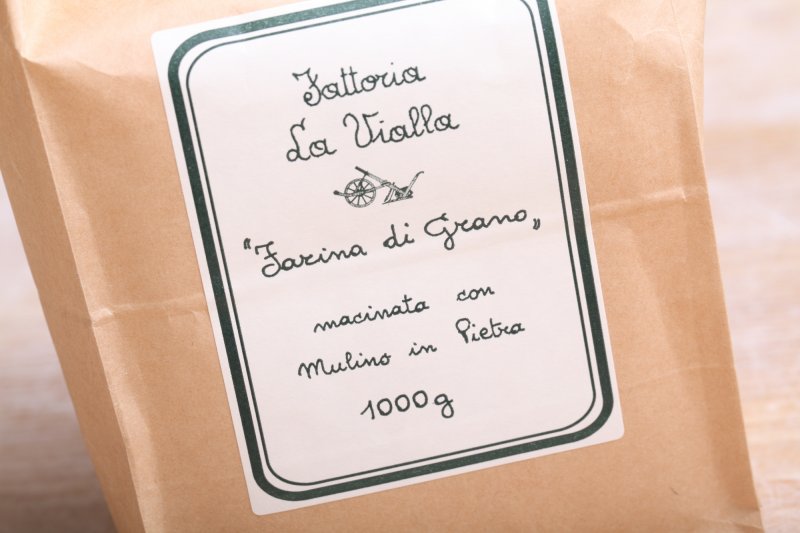
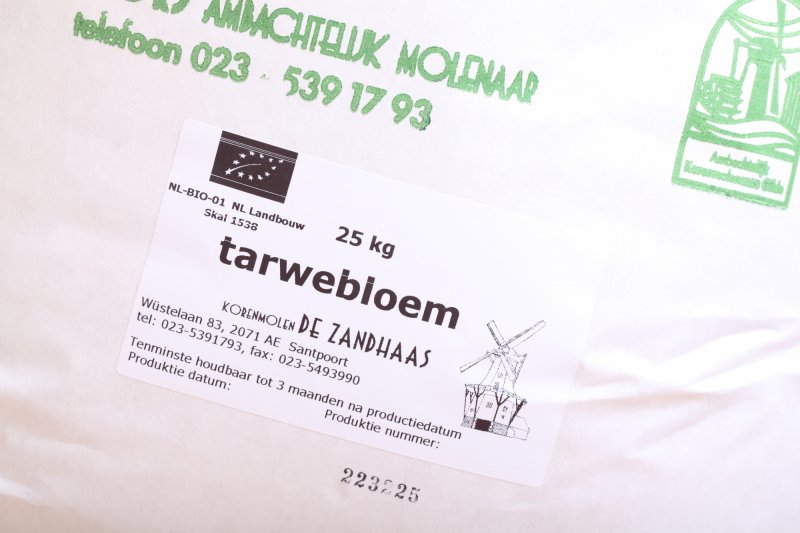
We get our flour from a windmill, which gets its wheat from the center of The Netherlands. They then grind it on big stones, powered by wind. The flour has an EKO (organic) seal of approval, a very nice yellowish hue from the natural carotene and it tastes of fresh grass and wheat berries. The flour is so fresh we have to ‘store’ it for 2 weeks to improve the baking properties and water absorption ability.
We are very lucky to have found great bread flour so close to home. How much difference it makes is also shown in our flour experiment for which we baked the same loaf with both high quality flour from a mill and cheap supermarket flour.
This flour overview teaches you more about flour types and how they are referred to in different countries. It can help you buy the right type of flour, no matter what country you bake in.
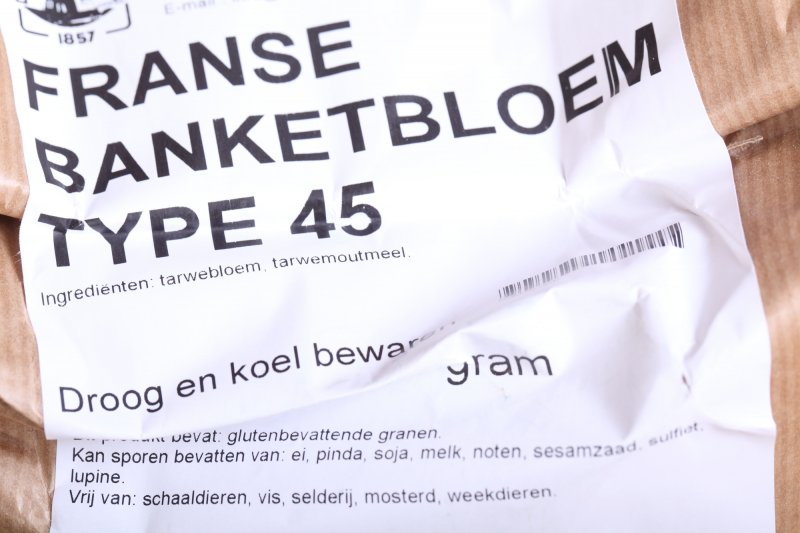
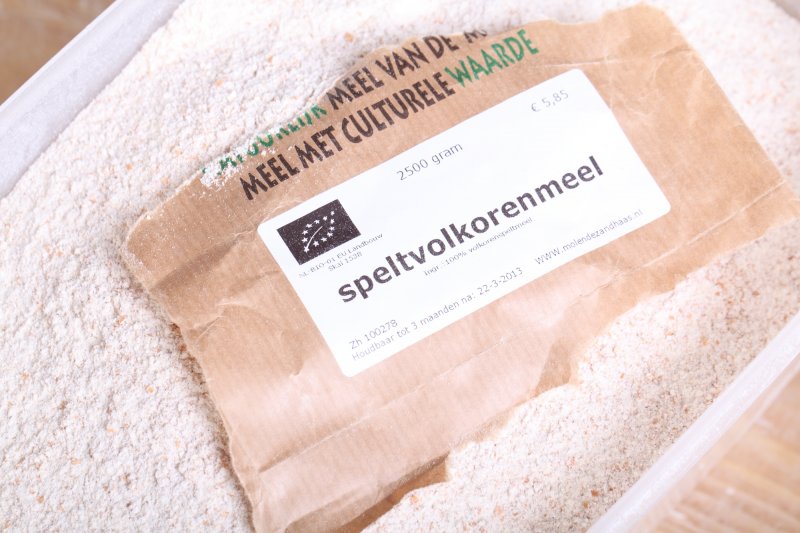
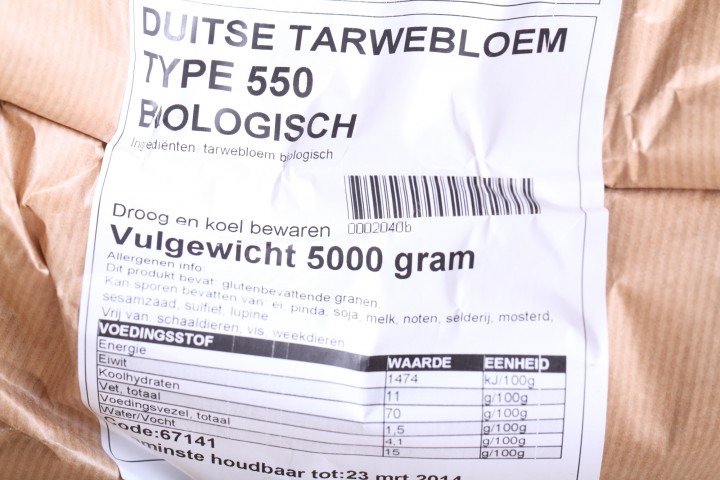
| Ash | Protein | US | German | French | Italian | Netherlands |
|---|---|---|---|---|---|---|
| ~ 0.4% | ~ 9% | pastry flour | 405 | 45 | 00 | zeeuwse bloem |
| ~ 0.55% | ~ 11% | all-purpose flour | 550 | 55 | 0 | patentbloem |
| ~ 0.8% | ~ 14% | high gluten flour | 812 | 80 | 1 | tarwebloem |
| ~ 1% | ~ 15% | first clear flour | 1050 | 110 | 2 | gebuilde bloem |
| > 1.5% | ~ 13% | whole wheat flour | 1700 | 150 | Farina integrale | volkorenmeel |
Ash content explained
To establish the ash content of flour a fixed amount of the flour is burned and what is left after this process is the ‘ash’. The amount that is left is expressed as a percentage of the original fixed amount. The ash consist of minerals that are left after burning, so they do not combust.
It is a way of determining the quality / purity of the flour. A higher ash content indicates that the flour contains more of the germ, bran, and outer endosperm. Lower ash content indicates that the flour is more refined. As you can see in the table above, the whole wheat flour has the highest ash content.
German flour type numbers (Mehltypen) indicate the amount of ash (unburned mineral content, measured in milligrams) obtained from 100 g of the dry mass of this flour. Standard wheat flours range from type 405 for normal white wheat flour for baking, to strong bread flour types 550, 812, and the darker types 1050 and 1700 for wholegrain breads. There is also a type 1600 which fits between white wheat flour and whole wheat flour, it will give you a darker white bread.
French flour type numbers indicate the ash content (in milligrams) per 10 g flour. The numbers are a factor 10 lower than the German types. Type 55 is the standard, hard-wheat white flour for baking, including puff pastries (“pâte feuilletée”). Type 45 is often called pastry flour, and is generally from a softer wheat (this corresponds to what older French texts call “farine de gruau”). Some recipes use Type 45 for croissants although many French bakers use Type 55 or a combination of Types 45 and 55. Types 65, 80, and 110 are strong bread flours of increasing darkness, and type 150 is a wholemeal flour. Note that there is no type 40 French flour like the German type 405, the closest is type 45.
In the United States and the United Kingdom, no numbered standardized flour types are defined, and the ash mass is only rarely given on the label by flour manufacturers. However, the legally required standard nutrition label specifies the protein content of the flour, which is also a way for comparing the extraction rates of different available flour types.
British flour types for bread baking:
Stoneground strong wholemeal* 100% extraction rate* – 12-14% protein
Stoneground wholemeal 95% extraction rate – 12-14% protein
Strong white extraction rate 72-75% – 12 to 13% protein
Extra strong white extraction rate 72-75% – 14 to 15% protein
Plain white 72-75% extraction rate – 9 to 11% protein (can be use to replace Italian 00 flour for example, but less suitable for most bread baking and most often used for cakes and cookies / biscuits)
Brown 80% extraction rate – 12-14% protein
*Extraction rate: The amount of original grain left in the flour. These extraction rates are not often mentioned on the bags. To make white flour you sift out germ and bran. If you sift out all the germ and bran it’s about 28% and you end up with 72% extraction flour.
*We often use the term wholewheat (like in America) but it means the same as the UK term wholemeal, but wholemeal can also refer to other grains like wholemeal spelt flour. In Holland we call this ‘volkoren’.
In the Netherlands it is even harder to establish the protein content and ash mass as most bags simply state ‘Tarwebloem’ or ‘Patentbloem’. As a general rule all flour, both ‘Tarwebloem’ and ‘Patentbloem’, you can buy in supermarkets have a low protein content and will not bake great bread. We have found out, by baking and experimenting a lot, that most ‘Tarwebloem’ flours sold by windmills in The Netherlands work well for baking artisan breads.
Soft wheat with lower protein content and less gluten is used for pastry. Hard wheat with higher protein content and more gluten is used for bread.
In general, as the extraction rate of the flour increases, so do both the protein and the ash content. However, as the extraction rate approaches 100% (whole meal), the protein content drops slightly, while the ash content continues to rise. Apart from the extraction rate itself the wheat can be of the soft or hard type. Hard wheat (usually hard spring wheat) has a higher gluten content (between 11% and 13%) and is excellent for baking bread. Soft wheat has a lower gluten content (between 9% and 11%) and is often used in all purpose flour and pastry flour which gives a more crumbly texture. Soft flour is usually divided into cake flour, which is the lowest in gluten, and pastry flour, which has slightly more gluten than cake flour. To make things even more complex, you can make whole wheat flour from soft wheat and patent flour from hard wheat and vice versa.
The English word for “flour” is originally a variant of the word “flower”. Both derive from the Old French fleur or flour, which had the literal meaning “blossom,” and a figurative meaning “the finest.” The phrase “fleur de farine” meant “the finest part of the meal,” since flour resulted from the elimination of coarse and unwanted matter from the grain during milling.
‘Dutch’ flour glossary
| Flour | Description |
|---|---|
| 00 bloem | Very fine Italian flour made of hard- or soft wheat. |
| Amerikaanse patent | A high protein content wheat flour, so very high in gluten. Found in Dutch bakeries under the name ‘lely’. |
| Bread flour | Usually to indicate a high protein content wheat flour (around 13%), so very high in gluten. |
| Durum | Triticum Durum, a wheat type with high protein content growing in warm areas. The germ has a yellow hue. Often used for Italian pasta. |
| Franse bloem | Very fine flour of only the germ and the endosperm. Often used for French baguettes. |
| Gebuilde bloem | Fine flour with only a part of the bran (usually has an extraction of 80% and 85%). |
| Grano Tenero | Soft wheat, low in gluten. Available in different extractions. |
| Grano Duro | Hard wheat, high in gluten. Available in different extractions. |
| Griesmeel | Coarse ground grains, for example wheat, spelt, corn or rice. |
| Kiem | Germ, the seed for a new plant, contains B vitamins, some protein, minerals and healthy oils. |
| Manitoba | A Canadian high protein content wheat flour, so very high in gluten. |
| Meellichaam / Meelkern | Endosperm, contains starch, protein, some vitamins and minerals. This is the food source for the germ to grow into a new plant. |
| Patentbloem | Very fine wheat flour without germ and bran. There is a big difference in quality between brands. |
| Patisserie bloem | Zeeuwse bloem or pastry flour. Very finy white flour with a low gluten content. |
| Semolina | Coarse ground grains, often from durum wheat. |
| Semolina rimacinata | Fine ground grains, often from durum wheat. |
| Tarwebloem | Fine ground wheat. Whiteness is between ‘patentbloem’ and ‘tarwemeel’. |
| Tarwemeel | A blend of ½ bread flour, ½ whole wheat, used in ‘tarwebrood’. |
| Volkorenmeel | The coarse ground complete wheat grain, contains the whole kernel, used for ‘volkorenbrood’. |
| Zachte bloem | Triticum Sativum, soft wheat flour with low to medium protein / gluten content. |
| Zeeuwse bloem | Fine flour with low gluten content, used for cookies and pastry. |
| Zemel | Bran, protective outer shell. High in fiber and B vitamins. |


Gisela says
Hi Ed & Marieke,
dank voor de goede uitleg in dit artikel! Ik werd er een beetje horendol van want op sommige sites wordt “all purpose flour” vertaald als tarwebloem en op sommige sites als patentbloem. Om in de kooksfeer te blijven; ik kon er geen chocola van maken :S. De reden waarom ik het aanhaal is omdat ik een via via een heel lekker Amerikaans recept heb gekregen voor ricotta cake wat om “all purpose flour” vraagt. Heeft Amerikaanse meel vanwege een betere tarwesoort niet juist meer proteïne/gluten dan het Nederlandse patentbloem? Zo rond de 12/12,5 %? En op sommige sites wordt aangegeven dat tarwebloem juist minder gluten heeft dan patentbloem. Zoals je begrijpt, ik word er horendol van 😉 . Ik wil het graag weten omdat ik dat recept wil maken en ik mij afvraag of patentbloem voldoende is of dat ik misschien toch moet proberen echte Amerikaanse all purpose flour te verkrijgen.
Weekend Bakers says
Hallo Gisela,
We begrijpen helemaal wat je bedoelt. Helaas lijkt er in Nederland geen wetenschappelijke basis voor een goed en overzichtelijk systeem, waarbij je uitgaat van de tarwesoort en eiwitgehalte en uitmaling vermeldt. Want het gaat er om welke soort en sterkte van tarwe dient als uitgangspunt om uiteindelijk te bepalen hoeveel proteïne de verschillende soorten meel en bloem hebben en dat is in Nederland überhaupt niet duidelijk. Je kunt dus ook niet zomaar, in de regel, zeggen dat tarwebloem meer of minder gluten heeft dan patentbloem, dat hangt dus af van wat e met elkaar vergelijkt en welk meel de basis was. Als je uit gaat van 1 meelsoort dan zal de tarwebloem die hiervan afkomstig is altijd meer gluten bevatten dan de patentversie. Amerikaanse all purpose flour heeft in de regel rond de 11% proteïne. We hebben even gekeken maar een heel bekend merk US flour en deze geeft een percentage aan van 11.7%. Dat zal inderdaad wat meer (kunnen) zijn dan de gemiddelde Nederlandse patentbloem, maar het probleem en de uitdaging in ons land is dus dat het eigenlijk nooit op de verpakking staat. Omdat het recept een cake is zouden wij zeggen dat je je over het glutengehalte ook niet zo druk hoeft te maken, omdat je met een cake juist geen elastische structuur wilt opbouwen maar waarschijnlijk een luchtig resultaat nastreeft en er ook niet gekneed wordt nemen we aan. We zouden dus aanraden het recept gewoon met patentbloem te maken.
Hopelijk heb je iets aan deze informatie en dragen we niet bij aan nog meer verwarring!
Succes met het recept en een goed (bak)weekend,
Ed & Marieke
susan says
What is the best substitute for French Bread Four? Thank you.
Weekend Bakers says
That would be a good quality wheat flour with a protein content of around 12 to 13%. We prefer organic flour from a mill (stone milled) because of the excellent baking results, also for making French baguettes for example.
GABRIELA PLIEGO says
Hello,
Sorry to say that the Easy Madeleine Recepie That Works, didn’t work for me. Madeleins were without structure at all and seems too much, too much, sugar in them.
I will try it agsin, but I would like to know if quantities are right?
With a harmful greeting. THANKS.
Weekend Bakers says
Hello Gabriela,
We can only say that these are the quantities we use (the same as pastry chef mr Suas uses in his book Advanced pastry), they are correct for us and give good results as you can hopefully judge from the pictures. Hope you will give it another try.
Marieke & Ed
PATHMANATHAN says
wow very interest
only talking flour what about [‘wheat’]????????
Joseph says
Hello out there…
I am an American of Dutch decent. My great-grandmother came to the U.S. with her family in 1923, and was an excellent cook, bringing lots of traditional Dutch baked goods to Christmas and Easter Dinners; however, when she died in 1986 the two surviving Matriarchs of the family had been in a long standing feud with eachother, with my Great-Aunt making off with Great-Grandma’s recipes. She has since passed away also and no one in the family has seen Great-Grandma’s recipe box since…can anyone out there point me in the direction of a good Dutch cookbook or web-based recipe collection (printed in English, since the only Dutch I know is “oliebollen” or profanity)? It would be greatly appreciated.
Thanks
Weekend Bakers says
Hi Joseph, a cook book with lots of classic Dutch recipes is ‘De banketbakker – Cees Holtkamp’ however it is totally in Dutch, at this point we do not know about a Dutch cook cook in English. Happy baking!
darlyne says
Hi! Just wondering if there is all purpose flour in the netherlands? I’ve been there last year and will be back this year for good. And i love baking cakes and cookies. I never saw all purpose flour there.
Weekend Bakers says
Hello Darlyne,
In Holland we do not have the exact equivalent of all purpose flour. On bags in supermarkets you will mostly see patentbloem and tarwebloem, the first is usually used for pastry and cookies, the second also for bread baking (see list above). If you want good quality and the right type of flour for your bakes it is best to visit a flour mill. You can find a list of good mills here: www.weekendbakery.com/posts…n-holland/. If you have anything specific you are baking and need our advise on what to buy or use, please just ask!
Welcome & Happy baking in Holland,
Marieke & Ed
Heather Lovering says
Please can you tell me the difference between French flours and English flour with baking improvers
Weekend Bakers says
Baking improvers are added to make up to ‘bad flour’ and ‘bad baking process’. When using good flour with enough strength and a good recipe you do not need the improvers. However factories and bread baking machines use them to make up for lack of time and lack of kneading action.
Vivian says
Hi there
I live in Amsterdam and I have yet been able to find any decent flour for baking bread. I moved from London where I could buy good quality organic flour (spelt, kamut, rye) very easily both online and in the shops. Can you recommend anywhere I can go to explore more interesting flours?
Thanks
Vivian
Weekend Bakers says
Hello Vivian, have a look at this page ; http://www.weekendbakery.com/posts/best-flour-mills-in-holland/
Chrissy Wortman says
Please can someone just say which flour to buy in the US that would make the beautiful light baguette that collapses down as you are eating not the dense memory foam ones everywhere.
From what I just read would it be the French with a 65 content?
Weekend Bakers says
Hello Chrissy,
All we can say from Europe is that if you are in a position to buy good French type 65 or also 55 flour in the US you should definitely give it a try when baking baguettes. For our own baguettes we use organic stone ground wheat flour (bread flour) with a protein content of around 12.5 % and this gives great results for us.
Good luck with finding the right flour.
Joseph says
In my own personal experience, here in the US, King Arthur Unbleached Bread Flour (with the blue label), makes excellent baguettes. Also, I worked in the bakery at a local grocery store back in my youth, and we used commercial bags of unbleached bread flour from Gold Medal, and we had great baguettes. As far as I’ve been told from customer service at General Mills, the Gold Medal Bread Flour, in the yellow labeled package, is the same product packaged for consumer use.
Joseph says
Also, keep in mind that along with the higher protein bread flour, much of your success will depend on how well you knead your dough. Kneading works the gluten you need for a good baguette. If you have a stand mixer, use a dough hook on medium speed until your dough gets a good “stretch” to it (mine, in my home takes about 10 minutes on average, but your results will vary). If you have to knead by hand, basically knead until your arms feel like their about ready to fall off.
Weekend Bakers says
Great advice, thanks for this addition Joseph!
Joseph says
If you are good with planning a day in advance, here is a great method for baking baguettes I found on the King Arthur web site, along with a link to their recipe. Just be sure to use a good unbleached bread flour, such as K.A.’s or Gold Medal’s bread flour.
www.kingarthurflour.com/blog/…s-at-home/
Rae says
Hi Joseph , after I posted my comment, I saw your posts. So I was looking type 65 and higher flour to bake Turkish pide bread. I bleached kind Arthur would work?
Terence Moore says
Hi I loved your breakdown of Dutch flours it makes things so much clearer. I just wanted to know where you buy your flour from in the Netherlands. I live in Amsterdam If you happen to know any good eco windmills. Also, what effect with using something like Speltmeel will have on your loaf i.e. a coarser texture or any tips when using a less finely ground ingredient.
Thanks! And keep baking
Weekend Bakers says
Hi, we buy most of our flours at Windmill ‘De Zandhaas’ at Santpoort-Zuid. They have very good eco flours! Spelt has less gluten and absorbs less water than regular flour.
Terry Parshall says
Just found your excellent web site. So much information to take in for a novice bread baker. I am looking forward to learning from weekendbaker. I have become impatient and tired of consuming the terrible quality breads found here in the United States in stores and even in specialty bakeries supposedly calling themselves bread bakers. I have begun making my own breads and have stopped buying bread from retail grocers. My efforts are modest and my knowledge is elementary but the bread I make at home is better than the bread I use to buy. I am hoping your site will help me to progress in this bread baking endeavor. I also just read you information on “flour types” and am amazed at the detail and intricacy of the subject. I try to use the best quality commercial flour I can find (Hudson Cream and King Aurthur, unbleached, unbromated) here in North Texas (McKinney) where I live. I know I have much more to learn. Is it possible to buy the “right” kind of flour here in the U.S.? Thanks for reading this. I will be reading and ordering from your site and will promote weekendbaker to friends and family who are interested in baking fine breads as well. Thanks so much.
Weekend Bakers says
Hello Terry, as we are situated in The Netherlands we really do not know where to get good flour in the US. Hope someone reading this from the US can help!
Happy baking!
Peter says
Nice to read up on this. Up until now I have always bought the “mix of the mill flour” (bloem van de molen), but last week I learned that this is a mix of “german flour” and “zeeuws flour”. I reckoned the guy in the shop meant regions. Now I read it is more concerning protein and gluten build-up. So actually I should be buying german flour if I want more gluten build up. At the moment my breads are a mixed success in oven spring and the beautiful artisan holes.
I know water percentage, technique and temperature are also factors (learning a lot from your site), but also inclined to think I am using a too weak flour for “artisan bread”. The mill is more catered to bread-baking-machine audience than people who do it more “old skool” as I see it. I will have a chat with the guy in the shop next weekend and try it out. Thanks for this (and the other) info.
Peter
Weekend Bakers says
We use regular ‘tarwebloem’ from the Zandhaas mill. We really like this flour for baking bread. It has medium gluten content and bakes and tastes great. For artisan bread you do not need very high gluten flour like manitoba, good allround bread flour works well. Most flour from France is also medium in strength and is used in breads and baguettes. The ‘zeeuwse flour’ is really meant for cookies and other patisserie, as it has low gluten content. We have almost no experience with flour from Germany. The grains from our Zandhaas flour comes the center of the Netherlands (Flevoland). Happy baking!
Paul Loopuyt says
Hi Ed & Marieke
In Amsterdam Noord hebben we sinds een tijdje een Poolse supermarkt (we noemen hem liefkozend “De Noordpool”; “even nog wat bier halen op de Noordpool”)
Ook in de rest van het land komen er steeds meer Poolse winkels bij, dus vandaar een tip voor mensen die op plekken wonen waar je niet altijd aan goed meel kan komen. In het Poolse assortiment verschillende soorten tarwemeel (Maka pszenna) ook prima broodmeel en met Duitse typenummers , roggemeel (Maka zytnia) goed bruikbaar voor zuurdesem, boekweitmeel (Maka gryczana), hele gerst (jeczmien) om te mouten en kiemen en nog een hele rits grutten (grys), gort (kasza), enz. waarvoor je alleen nog bij de natuurwinkel terecht kon.
Het is allemaal niet biologisch, maar wel van goede kwaliteit en niet te duur.
Liefs,
Paul
Weekend Bakers says
Dank je Paul voor deze waardevolle informatie en uitleg over de verschillende soorten meel. Meteen weer geleerd dat de Poolse bakkers ook de Duitse typenummers aanhouden. Klinkt heel aantrekkelijk om ook eens naar de Noordpool af te reizen ;). Hier vlakbij zit ook een kleine Poolse markt waar ik eens zal binnenlopen. Ik kan altijd onze Poolse vriend, die dol is op ons brood, meenemen als tolk.
Szczęśliwa pieczenia!
Raad says
Hi
First thanks for your helpe .
I want you to recommend me which type or number for french flour which would be used for roll and slice bread
What I will like to have is strong and a pure white colour for flour .
With many thanks
Raad says
Sorry just I like to add our bread it’s soft bread
Weekend Bakers says
We would recommend Manitoba flour which has a very high gluten content and the white colour you are looking for. Or use an all purpose or plain flour or French type 55 flour with extra gluten powder (about 2% of the flour weight) added to it.
Hope it works out.
Happy baking!
Helen says
Dear Ed and Marieke,
I have just finished reading this marvellous post and have printed it out to add to my bread book. Being extremely new to bread baking this has helped me enormously. Can I ask a few things – if you have tried using only spelt flour in many of your recipies and what your results were like and if you have used manitoba flour and what recipies you would recommend using it in. I was thinking that because of the high protien content this could be the best bread flour to use.
Many thanks!
helen
Martha says
Thank you so much. This has helped me a lot. Being Dutch/Indonesian and trying to make Dutch treats is very difficult for me. Now I know about the flour. This will help me. Again thanks.
Weekend Bakers says
Thank you for letting us know your appreciation Martha,
Happy baking!
Ed & Marieke
Miss Mary C Sanders says
Where in Uk can I purchase French Type 55 flour. I want to make a Stollen cake and I use gluten free white bread flour.
I want my Stollen to be more cake in texture and not bread in texture. Can you help and advise me please?
Mary S
Weekend Bakers says
Hello Mary,
Living in Holland we really are no experts in where to buy French flour in the UK. The only address we can give you is www.shipton-mill.com. If you want cake-like texture as a rule use low gluten flour (you are already an expert with that probably) and keep mixing to a minimum. If you want that texture and want to use the French flour you can also use Type 45 or a combination of 45 and 55.
Good luck with it and a very happy holiday season,
Marieke
Nancy says
I am going to make my grandmother’s Finnish Pulla bread, which is a sweet bread with cardamom. The recipe calls for three quarts of flour. Would that equal 12 dry cups?
What is the temp range of lukewarm milk?
Since this is an old recipe with “fresh farm milk,” should whole milk be used or is 1% ( which I usually buy) satisfactory?
Thank you !
Weekend Bakers says
Hello Nancy,
Living in Holland and having used scales all our lives, we are absolutely no experts in these units from old recipes. But we think that there are 4 cups in a quart, or 32 ounces. So yes, 3 quarts would be 12 cups of flour.
Lukewarm milk should feel around your body temperature so around 30 – 37°C or 87 – 97 °F.
If the recipe calls for fresh farm milk, we would use the whole milk.
Good luck with the recipe and happy baking!
Marieke & Ed
Angela Ross says
Hi there,
I am looking for organic semolina flour. do you know of a mill in Canada, preferably western Canada since I live in Invermere BC
I would like to purchase this organic flour in bulk.
thank you for your time,
Angela
Weekend Bakers says
Hello Angela,
Sorry Angela, can’t help you with that. We know nothing about mills in Canada. Maybe somebody else will….?
Marieke
Evelyn Felice says
Have been trying to find out why some Italian baking recipes call for a mix of 00 flour and Manitoba. I know about 00 flour but did not know what to look for in the US for the more elusive appellation Manitoba flour. Your site seems to solve this problem as Manitoba seems to have a higher gluten content than 00.
What I cannot understand is why this half and half? Would not type 0 fit the bill just the same?
I am a very amateur baker and too old to begin a study of the various properties of wheat, so would be obliged if you could give me a simple explanation of why these differences and what effect these differences would have on my baking.
Thanks so much.
Evelyn Felice
Giovanni says
Hey, I write from Italy.
Mixing Manitoba to 00 is a way to increase the strenght (W) of the 00 flour and so its capacity to absorbe water and to produce a strong gluten web which helps the development of the final loaf.
Why do we do that? Well, pretty simple: finding a 00 high gluten flour is very hard in our supermarket.s Even the 0 flour is not so rich in gluten.
Fortunately, home-baking is increasing and so now we are starting to see 00 high gluten flour in the supermarkets.
Bye!
Weekend Bakers says
Thank you Giovanni for your very helpful information. Glad to read that home baking is increasing in your country too! Our mill sold high gluten 00 flour for a while but stopped recently unfortunately.
Boon Seow says
Hi – would you know what’s the equivalent of French 55 flour in Australia?
Or do you export to Australia?
Thanks …….Boon
Weekend Bakers says
Hello,
Do you use the term ‘plain’ flour in Australia like the English do maybe? because that is what usually comes closest. The most important thing is the protein content, so look out for this information on the package if possible.
We do not sell flour ourselves.
Good luck with finding the right flour.
Marieke & Ed
Sarah Goodwin says
Good day.
My husband has a small artisan wood fired oven bakery in the Natal Midlands. We receive our stoneground, unbleached flour from a local mill and have recently had issues with the water absorption ability of the white flour. This is not just seasonal changes required to percentages of water in preferment. But after reading this article I feel it maybe due to the freshness of the flour. You mentioned storing your freshflor for 2 weeks to improve it’s absorption ability.
Would this help us? The flour seems to absorb the water upon first mixing. When coming back to fold the dough the flour is wet and sticky with not much elasticity. When leaving it over night in the fridge it rises and upon folding releases all it’s gases and goes back down to a more solid, sticky piece of dough.
Any ideas would be hugely appreciated.
Kind regards
Sarah
Weekend Bakers says
Hello Sarah,
Yes we do notice when using flour that is very recently milled (the day before) that the dough feels wetter and more sticky and two weeks of storage should be enough to ‘age’ the flour. After two or three weeks the flour absorbs slightly more water and has a little better gluten development. However the description you give maybe points to the fact that there seems to be less protein in the flour than you are used to. Do you know (or regularly measure or have measured) the protein content of each new batch of flour you get? It can vary and maybe explain why you now have a batch that acts the way you describe. Otherwise you should see improvement after two weeks.
Good luck with it!
Ed & Marieke
Marco says
Hello,
Thank you for this great page! I am trying desperately to find cake flour in the netherlands. Many people recommend zeeuwse bloem but it is the equivilent to pasrty flour 8.5%-9.5% protien. Cake flour should be 7%-8.5%. Any information on that would be very helpful.
Thank you!
Weekend Bakers says
Hello Marco,
When baking cakes most people in Holland use ‘patent bloem’, some will use Zeeuwse bloem if and when they can find it. The only flour advertised as cake flour is to be found in the supermarkets but they usually consist of pre-mixed ingredients, so more stuff than just the flour. To be honest we do not like this sort of stuff and we would buy or use it. Next to that it is very hard if not impossible to find any information on protein content on any package of flour over here.
Good luck with it!
Marieke
Raad says
Sorry T650 not T660
Raad says
Dear sir
Please can you helpe me I want bye franch wheat flour for bread type T550 and T660 export to Iraq , I want minimum 500 tons per month
If you can helpe me to send me the address or website for same flour mill in France
With many thanks
Raadrubaiy
Raadrubaiy@yahoo.co.uk
Weekend Bakers says
Hello Raad,
We are located in Holland and we do not sell flour or know of any big mill in France that does.
We buy the flour we use ourselves from a Mill in Holland. Maybe they can help you further.
See: www.de-zuidmolen.nl/contact.html
Good luck with it.
Marieke
Siesie says
Hallo Marieke,
ik vermoed dat Franse bloem (voor stokbrood) niet gemakkelijk in Nederland te krijgen is. Volgende week ga ik naar Frankrijk op vakantie. Het lijkt mij leuk om wat kilootjes Franse bloem mee te nemen. Weet je hoe het daar heet? Is het alleen geschikt voor stokbrood of kan ik er ook ander brood mee bakken? Misschien ciabatta?
ik ben nog niet zo lang begonnen met brood bakken en ik vind het ontzettend leuk. Een avontuur met al die soorten meel.
Alvast bedankt voor jouw antwoord.
Siesie
Weekend Bakers says
Hallo Siesie,
Je kunt dan vragen naar Farine de Blé Type 55. Dit is geschikt voor stokbrood maar je kunt er ook ander brood mee bakken, waaronder ciabatta.
Nog iets beter geschikt voor ‘pain rustique’ artisanale broden is Farine de Blé Type 65 en ook type 80 (als het goed is zeer hoog in eiwitgehalte). Type 45 is geschikt voor allerlei patisserie.
Heel veel plezier in Frankrijk en hopelijk kom je terug met prachtige Franse bloem!
Cuisson heureux
Marieke
Siesie says
Hallo Marieke,
hartelijk dank voor jouw antwoord. Ik zal je op de hoogte houden. Ik vind het wel spannend .
groet van
Siesie
Rozing says
Your information came into handy for me when trying to correspond the dutch flour type with the UK/US flour type. I always struggle to find out what is all-purpose flour is dutch. Another question is where can I find windmill flour around Delft/Den Haag/Rotterdam area? Do you have any idea? I was trying my best to find one nearby. Like what you’ve said that the windmill flour is indeed bake better. I have bought one last time during some farmer festival and then I can’t find them anymore.
Weekend Bakers says
Hello,
Have you seen our piece about windmills in Holland? See: www.weekendbakery.com/posts…n-holland/.
The mill in Schiedam (www.molendewalvisch.nl/) near Rotterdam would be a good option and maybe also this one in Gouda : www.flourpower.nl/. And if you ever are in the neighborhood of Haarlem we can recommend our own favorite mill ‘De Zandhaas’ in Santpoort.
Still some traveling to do maybe, but like you also experienced for yourself, it is worth it.
Good luck with it and happy baking!
Marieke
Wil says
Hi,
Did you ever use the German Type 1600? Last week I made some 50% wholewheat breads with whole wheat flour from De Vlijt in Wageningen NL and same recipe and handling with German Type 1600 from De Zuidmolen. First thing I noticed the dough was much firmer with German flour, even when we added more water. And the regular Volkorenmeel was not firm at all, so we ended up with much flatter breads. It also had much more visible bran.
So last friday I made a detour and visited De zandhaas. So tomorrow I will make the same bread again, but now with whole wheat flour from Zandhaas, De Vlijt and the German type 1600. I am sure this wil yield a lot of difference with the same recipe, all in the same Rofco B40 oven.. I will let you know the results.
Weekend Bakers says
We are more than interested to know the results Will! We have not tried the German 1600 ourselves, only the 550 and the French Type 65 and whole wheat from some other mills too. From one mill be had a packet named ‘supervolkoren’. It was clearly white flour with the fiber added to it afterwards instead of the whole grain being milled. We do not know if there was anything else added to this flour, the result was a rather ‘light’ bread.
Hope to hear about your results…
Have a great baking Sunday,
Ed & Marieke
Wil says
Well, I know the details now. Type 1600 is not the same as whole wheat. You can find all kind of details in my last blog post here: www.lekkermelig.nl/meelw…uits-meel/
Yes, I can fill the freezer now, but first I am going to compare the pizza baking capacities of my Rofco B40 with my woodfired clay oven. This is an unfair competition I think, but the Rofco probably has much higher baking capacity.
Weekend Bakers says
Hi Wil,
Thanks for sharing this. Super interesting! We also dived into a German baking book and based on that too we did an adjustment for the German flour. It states 1700 as whole wheat with the indication ‘schrot’ behind it. For now we will stick to that, but maybe some German bakers can help us with this too.
And pantry full of different flour (restjes) is very recognizable too 🙂
Wil says
Hi,
I think whole wheat is well, the whole wheat berries who have been milled to some regular flour, with all parts still present, Because there is a lot of variation in the product it can never be classified because sometimes the whole wheat will contain more ash then other times. So no DIN number for whole wheat, the number is fluctuating too much.
Weizenbackschrot 1700 is wheat with the germ removed. And as a reader of ketex.de states: Schrot ist kein Mehl. It is probably a lot coarser.
This is what e-baker.net says about it:
Für Vollkornbrote und -brötchen nutzt man das Weizenvollkornmehl. Da dieses alle Inhaltsstoffe des Korns enthält, hat es keine Typenzahl, wobei sich der Aschegehalt irgendwo bei einer 2000er Marke befinden dürfte.
So, if we are going to bake some real german Vollkorrnbrot, we should not shop for Type 1700 Schrot, and not for type 1600 Mehl. Type 1600 has a lot more protein in it. The real thing should be German whole wheat, which is actually available in the Netherlands. I wonder if it makes a lot of difference with Dutch whole wheat.
But yes, maybe some German baker kan comment on this!
Weekend Bakers says
Seems like we have to adjust again. You are very knowledgeable Wil, we do not need a German baker to help us this way 😉
Seems like, depending on where you buy your flour, results can also be totally different, same as over here really. So German bakers also have a challenge when producing whole wheat bread. Because of the fluctuations, results can differ with every batch, except probably with factory flour where whole wheat is fabricated.
Would be interesting to see a the results of a baking test comparing Dutch whole wheat with true German whole wheat.
Thanks again for your very useful info and happy baking!
Ed & Marieke
Wil says
Ok, yes, I hate it if I don’t understand it, so Google is your friend. Should we start some conversation now on French flour types 🙂 Just kidding.
By the way, I had some amazing feedback on the Zandhaas whole wheat. I have been baking for about a year now, but the family told me yesterday the Zandhaas whole wheat bread was the best they ever tasted until now. So yes, it really makes a difference what you buy. Next time I visit De Zuidmolen I will bring some German whole wheat and some other whole wheat from this source.
Happy baking!
Weekend Bakers says
Well, it would be interesting to try some different french flour, because now we only have one source. Would be nice to get some from a good mill in France.
Wil says
That won’t be so easy in The Netherlands. I think we have the same source.
Shipping cost in France is extremy high so although you can google on ‘farine artisanale vente en ligne’ the shops you will find wil not ship to NL or the shipping costs are already higher than the product itself.
Maybe you can ask some Dutch bakers who tell us they use French flour.
Or you could check with the commandeursmolen, I think they might have this (not on their website) but they mill all kind of wheat from NL, BE and the north of France.
Another route might be via Germany. I know at least two places in Germany where you can buy T65 online.
If you really want to have it I could put some effort in it. I know people in France and Germany, who visit my town in NL quite often, so I could ask them.
Magda says
Thanks so much for this!! Even though I have found my way around the Dutch flour system, I still needed this! 🙂
Weekend Bakers says
Your welcome Magda. Great to hear you were able to ‘crack the Dutch flour system’ which is probably one of the least informative in the world! Always good to have a reference to check things I agree.
Happy Baking,
Marieke
Karin Anderson (Karin's Bäckerei) says
Interesting to learn about the Dutch flour types as well.
I posted a flour type “translation” a while ago in my blog, comparing US flours with some European ones (hanseata.blogspot.com/2012/…ation.html), and I will include a link to your post.
Happy baking,
Karin
Weekend Bakers says
Hi Karin,
Thanks very much. We will take a look together at your post too. Sure there is something we can learn from it!
Happy Baking,
Marieke
Karin Anderson (Karin's Bäckerei) says
Thanks, Marieke.
By the way, American white whole wheat is an albino variety. The regular whole wheat flour is darker.