
IMG_5525

Rye Sourdough Starter in Easy Steps

My trusty, fruity rye sourdough starter culture

A lot has been written about sourdough starter cultures. You can find long and elaborate articles on how to make your own starter while using things like pineapple and grapes. They are almost mystical beings that you should treat with the utmost care and feed every evening at the same time while standing on your head. I have found out the truth is much simpler. My rye starter seems almost indestructible. The only thing I did is mix some whole grain rye flour with some water and wait…

What is a starter?

A starter is a piece of dough which contains wild yeast and bacteria which you use to make your bread. The wild yeast produce carbon dioxide (and a bit of alcohol too) to make your bread airy. It is the bacteria that can give your bread the sour taste, this is because the bacteria transform the starch of the flour into lactic acid, acetic acid and alcohol. Both the acid and the alcohol give sourdough bread their unique and interesting taste. You add an amount of your starter to a larger amount of flour and water mixture like you normally use commercial yeast to a poolish or a biga preferment. It works just the same only slower. Commercial yeasts are selected and bred for speed by the big yeast companies but wild yeast works at a slower pace. This is why bread recipes for sourdough bread tend to take much longer and consist of more steps.

Why a rye starter culture?

For my sourdough baking I use a culture which is made with 100% whole rye flour. A sourdough culture based on rye flour is easier to maintain, it does not go into a slurry like a wheat flour starter when you forget about it, it is easier to stir because it has almost no gluten and it smells very very nice, a bit like fruit. It is also very forgiving in the amount you feed it. Normally I only feed it once a week, after my weekend baking, I just give it a few table spoons of water and rye flour, stir, ready.

The birth of a new starter

How to make a rye starter Step by Step

First thing, you have to work clean. Use a clean jar and always use clean spoons to stir and add flour to the mixture. The organisms living on your hands can contaminate your starter and spoil it! Throw away your starter and start over when it develops an awful smell or grows moldy in whichever color, it probably has picked up a bad bacteria in the first feeble stages of the starters life. After some research I found that the most likely truth of the source of the yeast and bacteria is the flour itself. The yeast and bacteria live on the outside of the grain (just like the yeast to make wine lives on the skin of the grapes). This is why you need (preferably organic) whole grain rye flour, because you need the outside bran of the grain as a source of yeast and bacteria. I start with a relative wet starter and when the starter is alive you can add more flour to maintain a more stiff starter. I start with a small amount of water and flour as to not spoil too much flour, because you have to throw halve of the starter away with each refresh. When your starter is alive and kicking you always can scale up the size of your starter simply by adding more water and rye flour.

Be sure to use water which does not contain chlorine. Water companies add sometimes a little amount of chlorine to your tap water to kill all bacteria and probably also the yeast in the water, so it is not a good idea to use this for building a sourdough starter. If in doubt you can use spring/mineral bottled water.

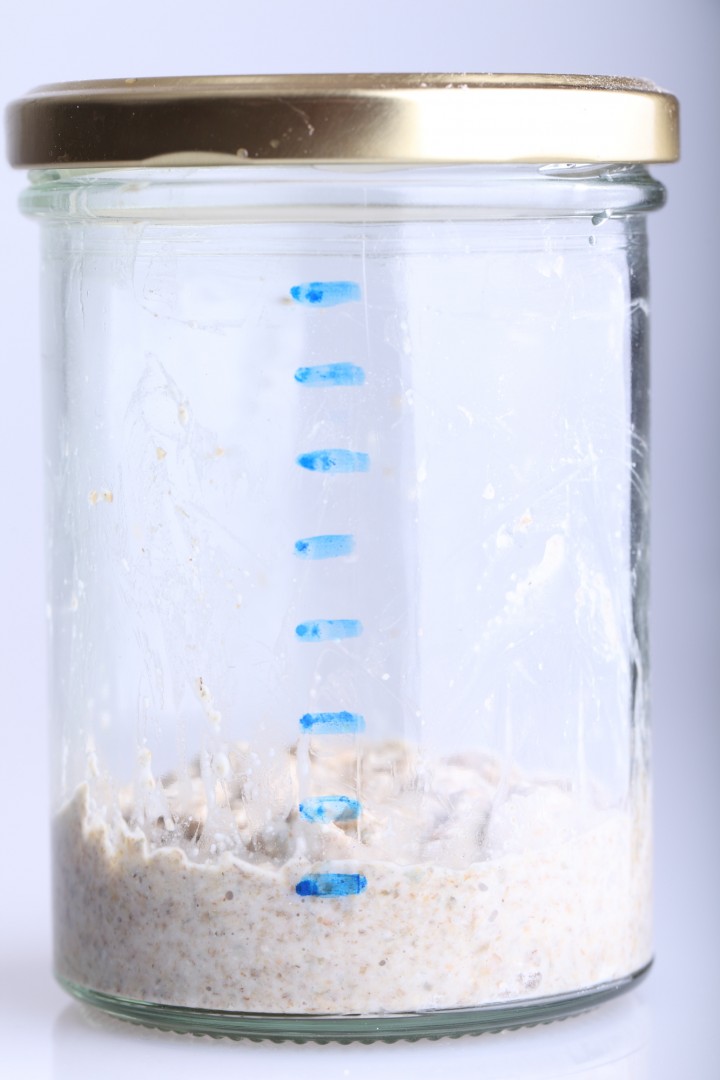
Day 1: Take a small clean jar (I use a 400ml jam jar) and add 40ml of water and 40g of whole grain rye flour, stir with a clean spoon for 30 seconds. Draw a line to mark the height of the mixture with a permanent marker on the jar so you can see any activity easily. Loosely close the lit of the jar and store at room temperature (about 20-21 degrees Celcius) out of direct sunlight for 24 hours.

Day 2: If you are lucky you should see some little bubbles of air in the mixture. The smell of the mixture at this stage is not very nice, a bit musty but not totally off putting. Add 20ml of water and 20g of whole grain rye flour. Stir with a clean spoon for 30 seconds. Draw a new mark line if needed. Loosely close the lit of the jar and store at room temperature out of direct sunlight for 24 hours.

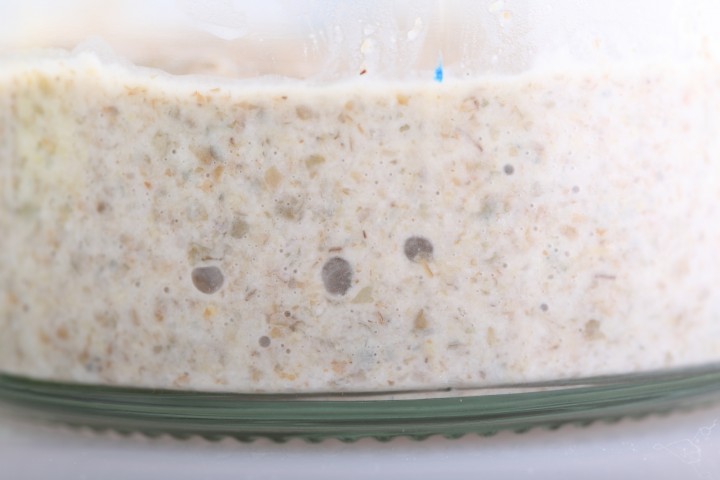
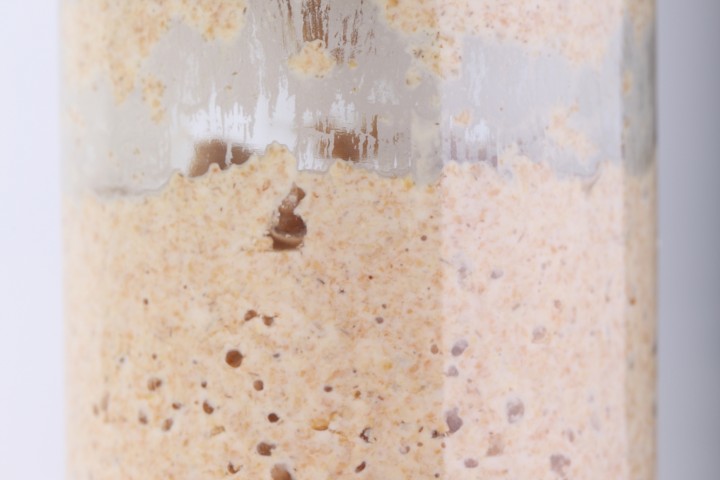
Some bubbles are visible after 24 hours – It’s alive, its alive…

Day 3: Your mixture should now be getting active. Mine did more than double in size during the last 24 hours. If your mixture is not very active yet, throw away half of the mixture and repeat the directions of day 2 again. The smell of your mixture should be a little nicer at this stage. When your mixture is active, throw away two third of the mixture and add 30ml of water and 30g of whole grain rye flour, stir with a clean spoon for 30 seconds and store at room temperature.

This is called refreshing or feeding your starter. By throwing out half of your mixture and adding new rye flour you give the starter fresh food (the rye flour) to work on, so all your new yeast and bacteria can get ‘stronger’ and multiple again. You also dilute the alcohol and the acid they produce so the yeast and bacteria do not ‘poison’ themselves.

Day 4: Your starter should now be fully active and strong enough to double or triple in size during a 24 hours time period. We need to refresh it again before we can use this starter because the acid producing bacteria need more time to develop than the yeast. So throw away two third of the mixture and add 30ml of water and 30g of whole grain rye flour, stir with a clean spoon for 30 seconds and store at room temperature.

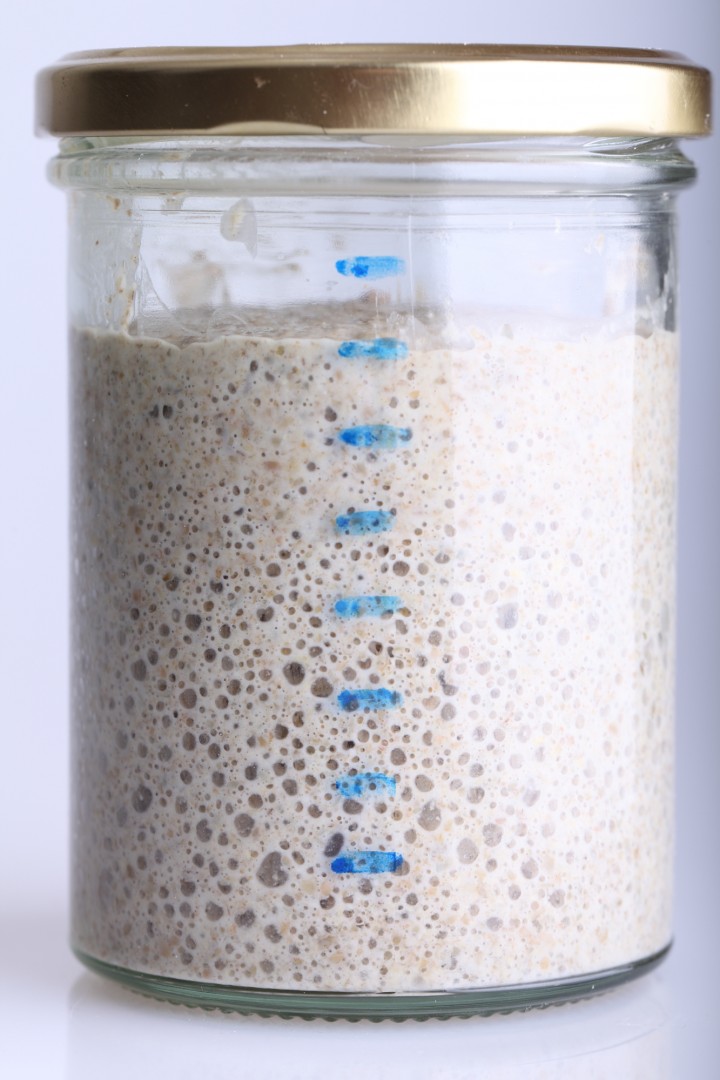
The starter is now 36 hours old and has tripled over the past 12 hours after feeding

Day 5: If your starter did at least double in size during the last refreshment your starter should now be ready for your first baking project. Also at this stage your starter should be developing a nice fruity smell during next few days. You can now let your starter rest for a few days, mine did develop a nice fruity tone on day 6 which got even nicer on day 7. If it did not double between day 4 and 5 repeat the directions at day 4. Just keep using and maintaining the starter from now, after a while the color of your starter should get a little bit more beige after it has tripled after a feeding (notice the difference in color of my old and new starter). This is a sign of maturation of the starter and the production of acid.

How to maintain your starter

My rye starter does not need much maintenance. I store my starter in the fridge (see update as to why). I bake almost every weekend so my starter is being refreshed at least each week. I keep about 120g of starter of which I use about 60g up to 100g each week (to bake 6-10 breads). I just add water and rye flour and stir so I have about 120g of starter again. I keep my starter a lot stiffer than when I started up a new culture, almost like a thick paste. The reason for this, it will develop a lot slower with less water, so it matures during the week and it is ready for baking the next weekend. After feeding I keep the starter on the kitchen table at room temperature for about 12 hours for it to develop and double or triple in size. When it has developed, I store it in the refrigerator until the next baking session. That ‘s it.

*UPDATE* I updated the instructions with the following info: Normally I just kept my sourdough starter on the bench in our little bakery for a week in between baking sessions, after feeding. This has worked for over 4 years but suddenly it stopped working. Even my new fresh starter developed a nail polish remover smell after a few days when stored this way. I still do not know why this happened. So now, after feeding, I wait for the starter to double or triple in size and then I store it in the refrigerator with the lit on. This way the starter keeps its lovely fruity smell.


Small video clip timelaps of rise of rye sourdough starter

We can also give you a head start with our own WKB rye sourdough culture. You can find it in our Bakery Tools webshop. But don’t be afraid to give it a try yourself first!

Share 'Rye Sourdough Starter in Easy Steps' on Delicious Share 'Rye Sourdough Starter in Easy Steps' on Digg Share 'Rye Sourdough Starter in Easy Steps' on Facebook Share 'Rye Sourdough Starter in Easy Steps' on Google+ Share 'Rye Sourdough Starter in Easy Steps' on LinkedIn Share 'Rye Sourdough Starter in Easy Steps' on Pinterest Share 'Rye Sourdough Starter in Easy Steps' on reddit Share 'Rye Sourdough Starter in Easy Steps' on StumbleUpon Share 'Rye Sourdough Starter in Easy Steps' on Twitter

140 Responses to Rye Sourdough Starter in Easy Steps

  1. Arden says:

    Heb inmiddels ook volgens jullie beschrijving een rogge starter gemaakt, staat lekker te bubbelen op mijn aanrecht :-) .

  2. Gerben says:

    Hello,

    I was really inspired by this website! So I started my own rye starter and the first three days it really started to work, but the fourth day it seemed ‘dead’. Do you have any idea what did go wrong? I refreshed it every day, maybe it is the room temperature. What are the ideal temperatures for the starter to grow?

    Thanks in advance!

    • Marieke says:

      Does you starter smell sour? Simply said; the bacteria make the acid/sourness, the yeast make the bubbles. When a starter gets too sour the acid stops the yeast from growing and making bubbles. By refreshing you give your starter new food to eat and you dilute the acid environment so the yeast come back to live again. Room temperature should be ok so around 20-22 Celsius. I advice at this point to throw away 3/4 of your starter and add flour and luke warm water (around 28-30 Celsius). Also keep the starter a bit wetter, so it is still easy to stir without being sloppy. This removes the acid and gives a nice warm wet environment for the organisms to grow in. Hopefully it springs back to life!

      • Gerben says:

        Thanks. I already started a new starter. And will try your suggestions on this. The old one does smell a little sour, also I see a different colour on the top layer of it, but I didn’t feed it yesterday because I already gave it up, so that might be the reason. Again thanks for your quick respons.

  3. Gerben says:

    Hi. My second starter also did not start up, despite my feeding and the attention I gave. Actually I am afraid it is the temperature that spoiled the fun. In my house it is always something like 18-18,5C during the day and colder at night. I have experimented with different places in the house, but without succes. Do you have any suggestions about how I can get the right temperature, without having to heat my entire house up to 20-22 degrees? Or should I wait until summer to try it again?

    Yesterday I baked my first pain rustique, using a dried sourdough starter. And actually it was a success. Do you have eperience with dried starters? Does it make a difference compared to living starters?

    • Weekend Bakers says:

      Hi Gerben,
      Maybe you could try the tip by Akke. And make sure your added water is not too cold. Sometimes quality of water can be an issue, for instance if it contains to much chlorine. You could use mineral water instead. Another idea would be to try a different brand/type of rye. Our rye from molen De Zandhaas in Santpoort seems to be full of life. We always make sure ours is fresh and we also use organic, there could be a difference.
      We do not have any experience with dried starters, but glad to hear it worked out fine and you made a great pain rustique. All I can add is give it another try with the tips and hints in mind. If I remember well ours was also ‘third time lucky’!

      • Gerben says:

        Hello Marieke,

        I started a new starter a week ago and it is really active now. So it must have been the temperature I guess. I just read your 4 year old starter died… my condoleances.

        Just to be sure, to maintain my starter I can just leave it for a week without feeding? How do I know if I have to feed it?

        Thanks for this great site!

        • Weekend Bakers says:

          Hello Gerben,

          Thank you, the new one is doing well again. Like it says in the ‘how to maintain your starter bit’: if your starter is stiff, like a paste, you can feed it ones a week, if it is more liquid, you should refresh it twice a week (normally bakers would use it every day of course). A good indication if feeding is called for is the smell. You recognize the smell of your active starter as rather fruity I think. If this smell changes to something less fresh and fruity, more resembling ‘nail polish’ it is time to feed your starter. By refreshing and stirring you give your culture fresh food to ‘chew on’ and you make sure everything is evenly distributed again and there aren’t any (crusty) subcultures developing on top for example.

          Hope your culture stays alive and happy!

  4. Akke says:

    You could try starting your starter in a coolingbox, together with some blankets and a nice warm waterbottle, next to the heating. I did it this way and it actually turned out fine.

  5. Sarah says:

    Thank you for this site. I’m starting a rye starter this month. It is not different than making any other kind of starter, which I have plenty of in the fridge, and in my closet.

    Here is a tip for people who are having problems with their starter. the water must be quite warm, a little above body temperature. I don’t know if you have crock pots where you live, but you can keep your starter in warm water where the temperature is more regulated. Try keeping your starter in a dark warm closet.

    I live in Canada and today it is -33C outside and my house, inside my house is 15c and my starter thrives really well.

  6. Steve says:

    Hi,

    Firstly I have to agree, what a great website!

    I’ve had a wholemeal wheat starter going for 13 days now and all seems to be going well. Not as fruity in smell as I expected but ‘yeasty’ nonetheless.
    I want to bake my first loaf with it this weekend but am not sure how much to use. Looking at the above usage figures (60-100grams) it appears that you use 10 grams per loaf; would this be sufficient for 1 loaf?

    Also you mention rising times take longer, is there a rough time guide for 1st and second risings?

    Many thanks for your help.

    • Weekend Bakers says:

      Hi Steve,
      Your wholemeal wheat starter is not as fruity as a rye starter, probably more ‘yogurty’ so it should be OK.
      I would suggest using 10 grams per loaf if you make a loaf like our pain rustique that also has a little bit of added yeast in the final dough. If you use only sourdough starter I would use 15 grams for a loaf.
      As far as rising times are concerned you can check our recipes for San Fransisco Sourdough, Mini Boules and Soft Sourdough Rolls. For the ‘hybrid’ version (little added yeast) check out the pain rustique and the loaf with toasted walnuts.
      Using only sourdough everything will take longer, but you also have to take into account the temperature of your dough which is really important. In our recipes the times indicated are about correct when your average dough temperature is 24ºC / 75ºF. You can find our tips on the subject here: http://www.weekendbakery.com/posts/a-few-tips-on-dough-temperature/

      Good luck with the baking and keep the starter alive ;) !

  7. Fran says:

    I am also having the day four problem. Starter looks superb on day 3, but after that there are no bubbles and it just sits in the jar. It still smells really nice, fruity just as you describe. I’ve tried three times, using organic rye flour, warm Tesco water and the temperature in my kitchen should be perfect.

    BTW – the raisin bun recipe is great. I’ve made them several times!

    • Weekend Bakers says:

      Hi Fran,
      If it looked great and had bubbles on day 3 then there was life in it, so that was a good sign, and the smell is also perfect you say. If you see no activity it could be it needs more ‘food’. You should just feed it then (on day 4) and see what happens.
      Always hard to judge without seeing it but maybe you will give it another try, also with the help of the kind suggestions you can find in the comments by other bakers.
      Just to be sure: I am assuming you use whole grain rye flour. Last tip would be to try another brand maybe.

      Glad you like the raisin buns!

  8. Fran says:

    I was determined to make my own starter so I decided to do some simultaneous experimentation. I started a rye batch and a batch with whole wheat. On day 3 instead of throwing away half of the mixtures I kept them all, feeding some with wheat, some with rye and some with white bread flour.

    Conclusions:
    1) They all worked. :)
    2) Rye smells nice than wheat. Wheat gets more liquidy and smells a little beery.
    3) No need to measure everything to the nearest gram. Now I add enough water to the flour to make a thick paste and mix the paste before adding to the existing mixture.
    4) Container is irrelevant, jars, bowls, tupperware all work fine.
    5) Water temperature doesn’t matter, I used it straight from fridge.

    Doing the experiments increased my comfort level with the process. I suspect that there was nothing wrong with my previous attempts, I worried too much about them doubling in the volume.

    I’ve baked a couple of pain rustiques and while there is lots of room for improvement, the results are on a different planet from previous breads using only packaged yeast! I am ready to tackle the SF sourdough.

    Thanks!

    • Weekend Bakers says:

      Hello Fran,

      I do so love that you didn’t give up and that you found your own way of getting comfortable with the stuff. This will stick with you for the rest of your life! And I am sure other people will benefit from your addition to this posting too!

      Thanks very much and enjoy the baking and the sourdough!

  9. gill flesher says:

    I also had the nail polish thing happen to my starter, but mine was only a couple of months old. On day 4 of a new one and all going well so far, although forgot to refresh it before dashing off to work. If I am just refreshing each week (whether I bake or not) can I just check that I should throw away about two thirds each time? Thanks, Gill

    • Weekend Bakers says:

      Yes Gill, about two thirds that is correct. If your starter is stiff, like a paste, you can feed it ones a week, if it is more liquid, you should probably refresh it twice a week. Some people use the ‘excess’ starter, the stuff you would trow away, to make a pancake batter, bake waffles, make English muffins and that sort of baking. see: http://www.thefreshloaf.com/node/11598/leftover-sourdough-starter

  10. Peter says:

    Ik volg al een tijdje jullie website en bewonder de resultaten.
    Zelf bak ik al een jaar of twee men vind dat dat over het algemeen heel aardig gaat. Tot nu toe is het maken van een starter miet gelukt, maar heb besloten het met jullie aanwijzingen nog eens te proberen.
    Nu kan ik echter bij de molen in mijn woonplaats roggemeel en roggebloem kopen. Welke van de twee is het beste te gebruiken om een starter te kweken? Ik dacht in eerste instantie roggemeel, maar mijn mengsel van de eerste dag is donkergrijs in plaats van het lichtbruin/grijs zoals op jullie foto’s.
    Graag zou ik jullie advies krijgen. Alvast bedankt voor de moeite.

    • Weekend Bakers says:

      Hallo Peter,

      Dank je wel! Met roggemeel (liefst biologisch want daar zitten potentieel de meeste gistcellen op) zit je goed zeker goed. Je hoeft je geen zorgen te maken over de kleur. Grijs hoort bij het jonge stadium van de cultuur. Na een tijdje, na het voeden en het verdubbelen in volume zul je zien dat de kleur verandert richting beige, dit is een teken dat de cultuur rijpt en dat de bacteriën zuren produceren. (en kleuren zijn op foto’s en bij verschillende beeldschermen ook moeilijk goed te beoordelen en vergelijken).
      Succes met je starter!

      Ed en Marieke

      • Peter says:

        Hallo Ed en Marieke,

        Het lijkt niet helemaal goed te gaan met mijn starter. Gisteren was dag 3 en hij was ongeveer verdubbeld, rook lekker en er zaten lekker veel luchtbel en in. Gisterenavond heb ik volgens de instructies 30 ml water en 30 gram roggemeel toegevoegd en geroerd.
        Vandaag echter is er qua volume niets gebeurd en ruikt het naar de hierboven genoemde nagellak remover.
        Heeft het zin om 2/3 weg te gooien en bij te voeden als op dag 3 of kan ik beter opnieuw beginnen?

        Bedankt alvast voor de hulp,
        Peter

        • Weekend Bakers says:

          Hoi Peter,
          Als eerste zou je kunnen proberen om nog eens 30 gram water en 30 gram meel toe te voegen, heel goed door te roeren en een dag te wachten. Als dat niet gewerkt heeft, dan ga je over naar de optie van het 2/3 weggooien en bij-voeden.
          Hoop dat dit resultaat heeft,

          Succes!

          Ed en Marieke

  11. Ìrene says:

    How much starter do I need to use for a bread made with 400 gram flour? Does anyone know how to determine how much starter does one need for making different breads (small loaf/large loaf)?
    thanks!

    • Weekend Bakers says:

      When using a preferment like a poolish or a biga I only use about 10 grams of active sourdough for each hydride loaf (a combination loaf of sourdough and yeast like our pain rustique) or about 15-20 grams of sourdough for a sourdough only loaf (like our whole wheat levain). With this small amount of sourdough you create during the night a fully active sourdough preferment which you will use to build the final dough. This way you can keep a small starter and still and have the full sourdough flavor. You can find both the recipes for the pain rustique and the whole wheat levain on our website.

      Ed

  12. Irene says:

    Dear Ed,
    thanks a lot for your explanation. It is now a Day 3 of my starter and I am having a problem! On day 2 I added 20 gr flour and 20 ml water, and already after 3-4 hours starter was doing very well (a lot of bubbles and it has more than doubled in size). But now, 12 hours after adding 20 gr flour and 20 ml water it lost its volume again and bubbles are fewer but they are bigger in size. It is also less stiff than it was.
    It is already second time that it happens, should I just proceed as you describe on the day 3? Any idea what can be the problem?
    I am using organic flour and spring water, and temperature is 22-23 degrees.
    Thanks in advance!

    • Weekend Bakers says:

      Hi Irene,
      It is hard to pinpoint the problem without seeing the actual starter. It sounds like your yeasties where already done eating because they ate all the sugars and stopped producing gas and so stopped making bubbels. They decided to go in hibernation, it doesn’t mean they are dead. Maybe they needed a little bit more than the 20 grams.
      If there is still activity I would suggest you just continue with the steps. If this does not work, and you think there is no activity anymore, go back to day 2 and take it from there. If this fails, throw away two third of the mixture and add 40 g of flour and 40 g of water. Remember, it is not exact science, a little bit less or more does not mean success or failure. You just have to find out how your starter reacts to the food and adjust a little accordingly.

      Good luck with it!

      Ed and Marieke

  13. Irene says:

    Hello Ed & Marieke, first of all thank you for the great site with an opportunity to ask a question and get an answer! For the beginners like me it is very valuable!
    I tried your advice with feeding starter with more flour and water, but it did not work. After 24 hours I smelled nail polish remover, so i discarded the starter. Also I started a new “batch” with an non-organic flour just to try. It gets active, but it needs more than 24 hours after each adding. Though, again, after 3 days (like with organic flour) I don’t see any activity, even after 30 hours. Does a taste can say anything about whether it is working or not?
    So, bottom line is that my starter with organic flour develops way faster (about 12 hours, instead of 24 as you describe), non organic flour starter develops much slower (30-34 hours). Do you think I can adjust the times accordingly, or does a starter always need at least 24 hours to develop? My problem with organic flour was that the process went as you describe for 12 hours (bubbles, doubling in size, right smell and color), but i waited 24 hours and at that point my starter lost its volume, got less activity and it got a layer of water on the surface. Do you have any advice for that? I want to start a new one tomorrow morning….
    Thanks a lot.

    • Weekend Bakers says:

      Hi Irene,
      It seems to us that your starter is so active that it maybe needs even more feeding. It is absolutely normal for a starter to rise and collapse, this is not a sign that something is going wrong. The ‘water’ on the surface is called hooch and it contains the alcohol made by your yeasts, you can poor it of. We have never seen it on a starter made with rye flour so we assume you are using wheat flour. We would like to point out that you only see activity after feeding, so when all the food has been eaten all the activity stops until you feed it again, this is normal, it does not mean anything is wrong. If you see no activity, do not stop, just keep on throwing away half and feed it again. You can try feeding it a bit sooner than you did up till now (maybe your surroundings are very warm?). So in short if your starter is very active and it is also very warm at the moment you could try going to a 12 hour feeding schedule instead of the 24 hours mentioned. Just try to keep it up for a week, do not stop at day three, with the more frequent feeding it should be alright.

      Good luck again and remember you are learning a lot from this process, also the things that seem to go wrong, you are getting to know your starter, it takes a bit of time but you will get there!

  14. Irene says:

    Dear Weekend Bakers,
    My starter is really active now (7 days) and I think I can refrigerate it (cannot get my house cool enough, minimum 25 degrees). Is it correct that after the feeding I should wait for 12 hours for starter to become active, and than refrigerate it? I wonder whether the starter will loose its volume when I refrigerate it, is it OK? And do I have to bring it back to the room temperature before I can use it for the next baking?

    Also, could you tell whether it is normal for a starter to have a thicker layer on top (like a crust)? Under this “crust” it is very active but air bubbles do not come through the top. I thought maybe this layer keeps starter from getting more volume (it only doubles, not more).
    Thank you very much for all the good advice!

    • Weekend Bakers says:

      Hi Irene,
      Great news about the starter! Good idea to put it in the fridge. You are correct to wait for 12 hours after feeding before doing this. Yes it will collapse and this is ok, it is only the air escaping. It is not necessary to bring it back to room temperature before using because you will use only a tiny amount compared to the rest of the preferment ingredients and usually this stays at room temp for about 12 hours so it will be OK.

      Again the thing you mention about the crust sounds like something that happens to a wheat culture (not so much with a rye culture which only shows a slight discoloration at the top). We assume you do put a lit on your jar, like it says in the instructions and that your crust is not really a hard crust but also more along the lines of a discoloration.
      Our suggestion would be to keep your starter a little bit stiffer, so it can rise a bit more. It is more important that the smell of the culture at this stage is yeasty, yogurty, fruity and slightly alcoholic (and not varnishy and off putting). If it smells nice and yeasty yogurty we think the moment has come for you to give it a try and bake a loaf with it. (see recipes for our pain rustique, mini boules, soft wheat rolls and whole wheat levain).

      Happy Baking!

  15. `paul van den broek says:

    nice site, tanks for puting it out there. It inspired me to try to build up the rye starter. From your video timelaps i can see how fast the starter is growin. I’m now in day4, had some activity yesterday: a small rise but by far not double. It even looked like it collapsed a bit. Today (day4) a bubble here, there but no real activity, it smells good by the way. Is this a fail or can this be saved? Does it often happen that no or almost no activity is there?

    regards, Paul van den Broek

    By the way, it very nice to see so many people starting to get interrested by food and esspecialy by our daily bread. Thanks for your good explenations on your experiences.

    • Weekend Bakers says:

      Hello Paul,
      Thanks for your lovely compliments. We would suggest the following for your starter: If there is still activity you can just continue with the steps. If this does not work, and you think there is no activity at all anymore, go back to day 2 and take it from there. If this fails, throw away two third of the mixture and add 40 g of flour and 40 g of water. Make sure the environment for your starer is warm and wet enough. If it still leads to nothing, you can also look at the rye flour itself. You see in our little clip that the rye we use is very active. We use organic whole rye flour from a mill and it seems to have a lot of natural yeast cells to get the starter going. It could be that the brand /type you use is not so easily activated, so maybe changing flour would help too. You can also read the comments and tips above of other people on the subject, maybe you find some of them useful too.

      Wish you good luck with the starter and happy baking!

      Ed and Marieke

  16. `paul van den broek says:

    happy! thanks for your reply and advise. It still seems a somewhat misterious proces (part of the fun). Yesterday i tried revive it, i threw away 2/3 and fed it 40gr rye and less water then described because I thought the mixture was to fluid. i think i added 20ml water and that did the trick. already yesterday evening it was more then trippled! Should i now give it a rest for 2 days or do a feed again?

    regards, Paul (@fooddutchie)

    • Weekend Bakers says:

      Great news Paul,
      You are right, that is why everybody has to find his or her own way with this process. We would advice to feed it one more time to proof it is really active. If it doubles / triples again you can try and bake something with it, or store it in the fridge until needed (also read the piece about maintaining your starter and our updates about the subject above).

      Happy baking!

  17. Francois (again) says:

    Should I make my sourdough culture with a lower hydration; 80 ratter than 100 percent? I think it would be great, in reason of the temperature of my house (25). I think that the pale colour of my culture is due to an over presence of bacteria, ratter than natural yeast… it doesn’t smell good as well. 80% water, 25 degree, 24hre intervals… does it seems okay ?

    • Weekend Bakers says:

      Hello Francois,
      Yes, we would suggest you give that a try. Like we said, it is not an exact science so you have to play around with it a bit to find your own optimal culture climate. Most people have to give it a few (or more) tries in order to get it going.

      Good luck!

  18. Ibrahim says:

    Hi Marieke,

    I am now at my first day.. but the equal parts of whole wheat rye flour and water is brining me a solid (dough consistancy) mixture. It looks like the flour soaked up the water totally. Is this normal or would you advice me to do (use) something different.

    Cheers!

    Ibrahim

    By the way.. the Naan Bread was perfect!! Lovely with the butter and cilantro.. and garlic :)

    • Weekend Bakers says:

      Hi Ibrahim,
      Glad the naan turned out so well, it’s one of my absolute favorite flatbreads.
      About the culture: sounds like it could use a little more water. It should be a consistency that can still be stirred with a spoon.

  19. inge says:

    Novice sourdough user – I’ve never baked bread using a sourdough starter, so am pleased to say my rye sourdough starter has come alive! but your help would be needed in that I’ve put it into the fridge as I’m unable to use it during the week (long working hours etc), so when I take it out of the fridge, do I only bring the amount I need to use back up to room temperature or all of it?

    Your help would be much appreciated.

    inge

    • Weekend Bakers says:

      Hello Inge,
      We also keep ours in the fridge and use it mostly at weekends (Weekend bakers :) and yes we work with the whole jar.
      You get the jar out, and take what you need to make your poolish or preferment. If you take just a little bit out to make just one loaf, you also need to trow away about half the content of your jar and fill it up with new flour and water to refresh it. (We bake much more than one loaf and use about 2/3 of the jar anyway so in that case you just fill it up and do not have to trow anything away). Then you leave it at room temperature for 12 to 16 hours to get fully active, put it in the fridge and leave it there till your next bake.

      Good luck with it!

      Marieke

  20. Pingback: How to make sourdough bread » Carl Legge

  21. Monica says:

    When my recipe says rye starter (150%) fed at 1:7:10.5 (starter:flour:water), What does this mean. I have baked bread before but have never used a starter except for sourdough pancakes following my Grandmas instructions of eyeing this much. Please help me to understand in laymans terms.

    • Weekend Bakers says:

      Hello Monica,
      150% (this is called a bakers percentage) indicates that your starter consists of 100 parts flour to 150 parts water (so about 1/3 more water than flour, so rather a sloppy starter). (100 to 150 is as 7 is to 10.5).

      For example: you maintain your starter by adding 70 grams of flour and 105 grams of water to 10 grams of starter, which brings the total of the starter to 185. If you refresh your starter you only keep 10 grams of the total starter and bake bread (or make granny’s pancakes) with the 175 gram you have. To feed the starter again add water and flour at the same ratio of 70 grams of flour and 105 grams of water.

      BTW, there are almost as many refresh ratio’s to be found on the internet as there are bakers, everybody seems to have their own preferred refresh ratio.

      Hope this helps and the recipe works.

      Happy baking and feeding,

      Marieke & Ed

  22. Monique says:

    Hoi, ik zit inmiddels op dag 5, na wat haperingen , maar nu lijkt de starter goed actief te zijn.
    Kan ik hem nu beter in de koelkast plaatsen en dan bijv. op dag 7 weer voeden/verversen, of kan ik hem op kamertemperatuur bewaren? En stel dat ik 1 brood wil gaan maken, na dag 7, neem ik dan de benodigde gevoedde starter …en wat doe ik met het overgebleven deel ? Graag jullie advies!
    Monique

  23. Monique says:

    Oeps ,zie nu net al een deel van mijn vraag al beantwoord bij 13 oktober…maar graag toch advies over waar de starter vanaf nu te plaatsen.

    • Weekend Bakers says:

      Hoi Monique,
      Leuk dat je starter het goed doet! Niet voeren en verversen als je je starter meteen gaat gebruiken. Na voeren moet je minimaal een dag wachten voordat je hem gebruikt. Als, zoals je zegt, je starter nu actief is dan kun je hem, als het gaat om maximaal twee dagen op een koel plekje in huis bewaren (maximaal 18 graden). Als je hem langer wilt bewaren dan is de koelkast de beste plek.
      Als je de starter voert, altijd eerst een dagje op kamertemperatuur laten groeien en dan pas in de koelkast zetten.

      Heel veel succes ermee,

      Ed en Marieke

  24. Frank says:

    Hallo,

    Thanks for the recipes, I love the 80% hydration baguette!
    As for the starter: when there’s a smell of nail polish this means the starter needs to be fed. All sugars have been eaten and now it is feeding on the fat producing acetone. If the acetone odour is not too strong it can still be ‘saved’ by refreshing.
    When stored in the refrigerator the processes are slowed down so the starter lasts longer without refreshing. Me too, I keep my starter in the refrigerator.

  25. Pingback: Rye Sourdough Starter in Easy Steps | cookandbake

  26. Alan Farrell says:

    Hi, just found this website and already I LOVE it! First starter went into the jar at mid-day today so watch this space! I have been making bread for about fifteen years now but only very simple and straightforward recipes (basic bread dough – wholemeal, granary etc). Now I can’t wait to try making some pain rustique by this method. Thank you for the inspiration.

    • Weekend Bakers says:

      Hello Alan,
      Wonderful! I hope you will like the pain rustique too. It is our favorite everyday bread. Give it a few tries to adapt it to your specific ingredients, equipment and surrounding because this can be different for everybody of course. But following the directions and tips we find that most people already get good results at the first attempt.

      A variation on the pain rustique is the ‘fluitje’ made with spelt flour. http://www.weekendbakery.com/posts/a-fluitje-with-spelt/ The recipe gives you two smaller loafs of about 500 g each. Nice for sharing too.

      Happy baking and thanks again for your warm words!

      Marieke

  27. Pingback: 15/29 « hokeypokeytad

  28. Pingback: hokeypokey 15/29 « Thing-a-Day 2012

  29. Pingback: hokeypokey 16/29 « Thing-a-Day 2012

  30. Pieter says:

    Marieke, Ed,

    My starter is working prefectly and is giving us every week 3 nice loafs, whether pain rustique, with prunes and walnuts or the real sourdough. I have a question though. I’m going for 9 days on holiday, will the sourdough starter last that long in the fridge. Alternative is that I take the starter with me.

    Keep up this marvelous site!
    pieter

    • Weekend Bakers says:

      Hi Pieter,
      You should be alright leaving it in the fridge while you are away. Back from your holiday immediately refresh, throw half away and add rye flour and keep at room temp for at least 24 hours.

      Enjoy your vacation and after that hopefully some more wonderful baking with the equally refreshed starter :)

      Marieke & Ed

  31. tsachi says:

    hi Marieke & Ed,
    first of all, thanks a lot for sharing your knowledge and experience in this Beautiful site,
    I’m learning a lot.
    I have a question about the starter. its the seventh day since I made the starter, and although
    it has nice smell of sourdough, and has alot of bubbles , its not expanding, meaning its on the same height all the time, except from the fifth day, when it was a little bit taller.
    I’m feeding the starter in a ratio of 2:1 feeding vs starter, because I’ve read its suppose to help.
    should I do something else ?
    thanks a lot

    tsachi

  32. Weekend Bakers says:

    Hello Tsachi,
    We would suggest first of all to keep your starter a little bit thicker, more like a paste. Perhaps your flour absorbs less water and this way the starter is more liquid and doesn’t climb that easily.
    Sometimes using a different type or brand of flour (preferably organic!) can also give a change for the better.

    Hope this helps,

    Ed

  33. Pingback: how to make San Francisco sourdough bread from scratch | cookandbake

  34. Pingback: sourdough recipe reblog (and my own previous attempt) | cookandbake

  35. Pingback: Sourdough « Inclusive Parenting

  36. smokehag says:

    Love your starter. Recommend it on my blog as its nice and simple and not confusing for beginners.

  37. Wiley says:

    Hello,
    Thanks for your website; it’s very helpful.
    This is day 3 of my first effort at making starter, using an organic rye flour. All seemed as you describe on the first day. After feeding on day 2 there was a rapid increase in activity and after about 6 hours the volume had increased nearly 4 times. It was nearly overflowing the jar so I shook it and it collapsed back to near its starting volume. Then I left it for the remainder of the 24 hour period, and it didn’t rise again.
    Now on day 3, it’s about 6 hours after I removed half of the batch and fed the remainder, and there has been very little rise, just enough to be noticeable. After reading through the comments here, I’m guessing that since it was so active yesterday I should have fed it again after it collapsed instead of waiting the full 24 hours, which is what I’ll try if the same thing happens in the future. Since there’s still some activity I’ll continue working with this batch and see how it goes.
    Again, the info. on your site is much appreciated.

    • Weekend Bakers says:

      Hello Wiley,
      Thanks! I think your analyses is pretty accurate and you should just continue. I think your starter is very active and wants to be fed sooner rather than later. BTW The collapsing is normal, it will not stay high forever, it will collapse in a day or sooner like in your case. Also the wetter the more the tendency of collapsing. Just keep going, do not stop or start over just because you think nothing much is happening anymore. Hope it works out!

      Ed

  38. Oleg says:

    Dear Ed & Marieke,

    Let me notice once again, that you have a great website! I think the best all around about bakery!!!

    A quick question about starter and temperature.
    It’s very humid and hot (29C) in Chicago now, so the question is will I still be able to make the Rye Sourdough Starter or should I wait for fall time when temperature drops?

    Thanks a lot and best wishes!!!

    Oleg

    • Weekend Bakers says:

      Hello Oleg,

      You do not have to wait. It may be that because of the temperature your culture will be a little bit more active and you have to feed it a bit sooner than the average times given in the instructions. You can keep it in a place that is relatively the coolest in your home maybe.

      Good luck,

      Ed & Marieke

      • Oleg says:

        Ed & Marieke,

        Thanks a lot for your answer!!!
        Actually whatever I thought is dead starter started raise almost on my eyes when I added flour/water. Now it looks/smells perfect, but I have to feed it every 12 hours.

        Can I ask you a question about “how to maintain your starter” part, please?

        In your update you wrote “after feeding, I wait for the starter to double or triple in size and then I store it in the refrigerator with the lit on.” Do you feed it before put into the frige? Do you need to feed it when you take it out of the frige or you can use it right away?

        Thank a lot!!!
        Oleg

        P.S. This weekend wil be my “Bake a Miche” day

        • Weekend Bakers says:

          Hi Oleg,
          Great to hear! To answer your question: No, you do not feed it again just before you store it in the fridge.
          If you keep your culture in the fridge, refresh your culture at least every three weeks. If you want to bake, get it out one day in advance. If it has been left in the fridge for over a week you need to refresh / feed it first so it will be ready and active the following day.

          Hope the miche baking will go great. Allow enough time for the resting, proofing and baking, you must not be in a hurry with a miche! But if it is still as hot as a while ago, the proofing will probably also go rather fast, like with your starter.

          Have a great baking weekend,

          Ed & Marieke

  39. Oleg says:

    Ed & Marieke,

    One more question about teh starter.

    The starter is great and I am really happy with it, but I have a question about it usage.

    Should I use it only when I bake rye bread or can use with wheat bread as well?
    Right now I am thinking about baking “Poilâne Loaf” and wonder if I have to convert this rye starter into wheat starter? I read how to do it and it should not be a problem, but I am still wonder if I can still use rye starter for non-rye bread.

    Thanks a lot,
    Oleg

    • Weekend Bakers says:

      You can use your starter for any bread you like, also wheat or spelt. There is no conversion needed! We use our rye starter all the time for all kinds of bread. The only reason for not using a rye starter would be if you really would not want any rye in your bread. But the amount compared to the loaf is so small, (plus in your loaf there will probably be whole grain wheat and maybe some additional rye anyway) that you will not even notice any difference using a wheat or rye starter.

      Hope your loaf will be great!

      Marieke & Ed

  40. Kat says:

    Hey there…hoping you can help. I’m struggling with my starter. All was going well and on day 3 it rose a little and had some bubbles. I carried on following instructions and since then it has had no life in it. I’m using mineral water and warming it to about 36c but room is about 18c. I am now on day 9!

    Anyway….do I carry on or start over? What might I be doing wrong? I’m so looking forward to doing some baking baking! Help!

    Thanks.

    • Weekend Bakers says:

      Hello Kat,

      Our first thought are your water is too warm, so the suggestion is to use water of 30C at the most. Plus (provided you are not already doing this of course) we would recommend looking at your flour. Use organic (preferably wholegrain rye) flour because it gives you the greatest chance of success, change brands to see if this helps.
      But first, start over again and lower the temperature of the water so the temp for the yeast cells will be more comfortable.
      Another thing you can try in combination with this is finding a spot in the house that is slightly warmer (20-21C).

      Good luck with it!

      Ed and Marieke

  41. jo says:

    Hi,

    What texture should the starter be at the beginning? Mine is extremely thick & dry, like dough, and stuck to the spoon.

  42. Stash Bragiel says:

    Hi,

    if you are having problems with your sourdough starter failing feed it with 100ml of “unsweetened pine-apple juice. This will help with the bad bacteria. Try it!

  43. Pingback: Zuurdesem Pain Naturel | Lekker melig!

  44. Pingback: MartaPapiol.com » Blog Archive » 2n intent fallit :(

  45. Olga says:

    Hoi Ed en Marieke,

    Ik heb een vraag over de hoeveelheid van dit zuurdesem dat je moet gebruiken in een recept. In de meeste recepten wordt ‘normale’ instant gist gebruikt. Kan ik dit ook vervangen door de rogge zuurdesem? En zo ja, hoeveel van dit desem gebruik je dan (bijv. per gram instant gist)? Is daar een handvat voor?
    Alvast bedankt.

    Groetjes,
    Olga

    • Weekend Bakers says:

      Hoi Olga,

      Je kunt helaas niet zomaar gist vervangen door zuurdesem en verder gewoon het recept volgen. Desem heeft namelijk veel meer tijd nodig om tot ontwikkeling te komen. Het werkt het beste om gewoon een goed desemrecept te nemen omdat daarvan alle tijden en methodes kloppen (bv de pain naturel: http://www.weekendbakery.com/posts/sourdough-pain-naturel/ of de zuurdesem mini boules: http://www.weekendbakery.com/posts/sourdough-mini-boulles/). Je kunt een gistrecept wel bewerken zodat het een desemrecept wordt. Je moet dan altijd met een voordeeg werken om de boel op gang te brengen. Gemiddeld zit er in een desembrood dat op deze manier wordt gemaakt ongeveer 15 g desem per brood. Dan heb je ook nog de hybride versie (zoals de pain rustique: http://www.weekendbakery.com/posts/our-version-of-a-pain-rustique/) waarbij je het toegevoegde desem meer voor de smaak gebruikt en het gist toevoegt om het hele proces meer snelheid te geven. Bij al deze methodes, gist, desem of hydride, krijg je ook duidelijk een ander type brood (korst, kruim, smaak).

      Groetjes en happy baking weekend!

      Marieke & Ed

      • Olga says:

        Super bedankt voor je reactie. Ik wilde eigenlijk een speltvolkorenbrood maken met de roggedesem, maar ik kon er nergens een recept van vinden, vandaar mijn vraag. Ik ga het eens met de 15 gram desem proberen en een voordeegje maken.

        Groetjes,
        Olga

  46. Pingback: Sourdough Rye Bread | Some Kind of Healthy

  47. Marie says:

    Hi,
    How much of the starter would I use to make Rugbrod? This is a Danish type of rye bread, like German pumpernickle. It is a very large loaf – 1kg of rye flour plus 200 grams of rye kernals.

    • Weekend Bakers says:

      It depends on the recipe. If it uses a poolish or preferment in which you put the starter you would need around 30 g per 500 g flour. If you don’t use a poolish or preferment you would need between 200 g and 300 g active starter. But note that simply changing a yeast based recipe to sourdough, without changing timings and techniques will not immediately result in a good loaf the first time. We would suggest you stick to a good / proven sourdough based rugbrod recipe for the best result. We have not made the original rugbrod ourselves. We do have a favorite rye bread recipe, it is a so called ‘hybrid’ version because it uses the rye starter plus a tiny amount of yeast in the last stage of this three stage recipe: http://www.weekendbakery.com/posts/3-stage-70-rye-bread-with-raisins/. Our other recipe, a very dark and moist rye bread, that uses no starter or yeast at all and is ‘cooked’ for 10 hours is also very much worth a try for true rye lovers. You can find it here: http://www.weekendbakery.com/posts/the-best-rye-bread/

      Good luck with the baking,

      Ed & Marieke

  48. Marie says:

    Thanks for your reply. I made the bread from blargh.stderr.net/2009/09/16/danish-ryebread-.Rugbrod. It has a starter but uses a little bit of yeast so it doesn’t have much of a sourdough taste. It did work well, however. I think i will search for a recipe with a true sourdough instead of tinkering with this one . Thanks, again.

  49. gregory says:

    Hello weekend bakers,

    This question is more about baking bread than about starter. Your tips on the starter were great and really helped me get it going. I used it for a recipe from the book “Healing with Whole Foods.” The recipe was for Black Rye Bread. Just starter, rye, water, and a little salt. No sweetener or anything. Maybe a little too healthy.

    My question is about what it should taste like. I’ve never had rye sourdough before. It tastes like rye, but I’m disappointed that it didn’t get that tangy sour taste that most wheat sourdoughs get. Should it get sour, even with 100% rye flour?

    Thanks!

    • Weekend Bakers says:

      Hard to say. It really depends on the recipe and we do not know the recipe you used. However, the acid producing bacteria in your sourdough culture need lots and lots of hours to produce enough acid before you can taste it. That is why San Fransisco sourdough bakers have bulk fermenting times of 12 hours plus+ and use refrigerators to stretch those times further to 24 hours or more. So rye sourdough can get that tang, but you need to find the right recipe with the right proofing times.

      Thanks for all your kind words and good luck with the rye bread project.

      Ed & Marieke

  50. gregory says:

    Well, it all got eaten. So it must have been pretty good. Thanks for the help. I will keep experimenting and baking.
    Merry Christmas and Happy New Year!

    • Weekend Bakers says:

      Merry Christmas and a Happy New Year to you and your family too Gregory, and lots of baking joy!

      Ed & Marieke

  51. Adrian says:

    Hi Ed and Marieke

    I’m very new to sourdough and bread baking in general but ever since I tasted the sourdough baguette at a local restaurant I’ve put it down at the top of my to-bake list. I’m considering of purchasing the sourdough starter from your weekend baking shop but as it’s a rye starter I wonder if it can be used for baking baguettes and other recipes that call for a white flour starter?

    Many thanks and I hope to try your 80% hydration baguette one more time in the coming week!

    Adrian

  52. Adam says:

    I am new to this. I can make a good yeast / preferment white country bread. My goal, though, is to make this German bread linked below. I don’t know how to calculate hydration percentages. Can I achieve 133% with this recipe of yours? Any advice is greatly appreciated. Happy New Year! Adam

    • Weekend Bakers says:

      Hello Adam,
      Baker’s percent(ingredient) = 100% × ingredient mass⁄flour mass
      Our starter culture uses equal parts water and flour so it is 100%
      The 133% in the recipe you want to make means it is wetter than our starter.
      This is how you calculate the ratio
      The 80 g culture is 100 parts flour and 133 parts water = 233 parts in total.
      80 / 233 parts x 100 = 34.33 g flour and 80 – 34.33= 45.66 g water
      So you could just add about 10 ml water to the recipe and then all will be fine!

      Good luck with the recipe, it sounds and looks delicious!

      Happy Baking and Happy New Year!

      Marieke & Ed

  53. Ben says:

    Hi,

    I’m a new comer to the world of baking and have a quick question on starter volumes. In your guide above, after doing the maths at the end of day 4 you’d only have around 50g of starter. After this you say let it rest for a few days to develop. But what is the process when you need a large amount for a recipe? I’ve read a few that require 100g or even up to 200g. Is the below what you would do for a recipe that requires 100g of starter:

    - throw away 2/3 (33g) of your 50g starter that you’ve developed, then add 133g of flour and water.

    from this point i’m not sure how long you’d need to leave this new amount of starter before you used it, as you’ve really diluted it and don’t understand how long the new flour you add takes to develop the flavour that the starter has in it. But after x amount of time you’d then take the 100g need and have the original 50g left over to keep and store.

    Sorry if the answer is obvious – and any help on this is greatly appreciated. Plus I love the website and have learnt so much from it already.

    Here’s to 2013 being the year of the bread !!!!

    • Weekend Bakers says:

      Hello Ben,
      There seem to be two schools of thought when it comes to using sourdough cultures in recipes for bread making. One tells you to refresh your starter the day before baking and add a large amount of this starter to your final dough on baking day. The second tells you to build a poolish by using a small amount of sourdough added to equal amounts of flour and water and let it ferment (ripe) for usually around 12 hours. It more or less comes down to the same result as in the first method you use your starter as a poolish but the downside of this is you have to maintain a large amount of starter. The second method you maintain a small amount and let it increase in size the day before baking in a separate container. With this second method you do not have to throw away as much starter when you refresh (feed/ maintain) it.
      This is also why most of our recipes use this method that tells you to build a poolish type preferment with a small amount of culture.
      Another advantage of this method is you can use a rye starter (easier to maintain) with regular white sourdough loaves, as the amount of rye used is so small you will (almost) not notice it in the final bread.

      Hope this helps and wishing you lots of happy baking moments in 2013!

      Ed & Marieke

      • Ben says:

        Thanks for the advice guys. have already started a new starter following your guide above. looking forward to the results this weekend!

        • Weekend Bakers says:

          Let us know how it goes!

          • Ben says:

            Hi guys,

            Starters are going really well, and hope to try out some of your recipes this weekend. One question though. You mention that instead of a large amount of starter you can build the same amount of poolish and use this instead. If this is the case is there a general way to calculate how you convert a recipe that includes a large starter amount to one that would use a poolish? An example recipe I have for pain de campagne is:

            650g bread flour
            100g rye flour
            500g sourdough starter
            etc

            this is just one example but would like to know what you’d do for any recipes you come across and you want to substitute starter for poolish.

            thanks,
            Ben

          • Weekend Bakers says:

            As a rule of thumb you can use 15 g sourdough culture to 100 g flour used to make a sourdough starter. After mixing your starter it needs about 12 hours (usually overnight) to become active.

            Ed

  54. Sylvia Vervest says:

    Hi

    After two disasters with a wheat sourdough starter I am now going to try your Rye starter and if that doesn’t work I’ll throw in the towel (well maybe not that quick – lol). I do, however, have a question, you mentioned about using mineral water if tap water has a lot of chlorine in it. Being a Brit lIving in The Netherlands I think the water here is not chlorinated (although I could be wrong!) but to avoid any problems would it be prudent to use mineral water.

    • Weekend Bakers says:

      Hello Sylvia,

      I can assure you it is not at all necessary to use mineral water, the tap water here is fine. It is mentioned for people who live in areas where there is a lot of chlorine in the water (parts of the USA for example). We use tap water for our culture too.
      Hope the rye will bring you success. Do not give up yet! Use organic whole rye for the starter (we use De Zandhaas), it will create the best conditions for an active starter.

      Good luck with it, otherwise, if and when you visit us, we will help you by showing what we do.

      Marieke

  55. Sylvia Vervest says:

    Hi Marieke,

    Thanks for that, must admit I felt a bit stupid asking that but I’ve been so frustrated with sourdough bread making and I really wanted to follow everything to the T and I did think it was for your USA followers. I have been making spelt bread and basic wheat bread since I started making bread (about a month or so ago) and the results are great but sourdough bread seems to elude me for some reason. I’m off to the Zandhaas later this week and I’ll pick up some organic Rye flour (Roggameel?!) as well. BTW the organic wheat flour from there is just the best thing ‘since sliced bread’ – pardon the pun :-)

    • Weekend Bakers says:

      Hi Sylvia,
      Great to hear you like the flour! The thing to ask for is EKO (stands for organic) roggemeel. I hope by using this flour your frustrations with sourdough will come to an end. Next to the right flour for your starter culture it is also important to keep in mind that making sourdough bread takes time (about twice as long as yeast bread you could say) and it is really important to have your dough at the right temperature (24-25 C) otherwise it will seem like nothing is happening with your dough. (Maybe you have seen our tips on dough temperature: http://www.weekendbakery.com/posts/a-few-tips-on-dough-temperature/).

      Good luck with it and keep us posted?!

      Marieke

  56. Anna says:

    Goedemiddag!
    Ik heb een vraagje over het gebruik van de desemstarter. Ben in verwarring over het koelkastgedeelte.
    Als je starter actief is, klopt dan het volgende:
    Je pakt er ‘s avonds een hoeveelheid van, voegt daar gelijke delen water en roggemeel aan toe. Dat laat je 12 uur staan op kamertemperatuur. De volgende ochtend kun je daarmee bakken.
    De rest van de starter zet je in de koelkast, ook ververst. De volgende keer dat je wilt bakken haal je er weer een gedeelte eruit, etc, zie boven. En ververs je ook weer de voorraad die in de koelkast gaat.

    Of kan het alleen andersom. Dus dat je voor je wilt bakken eerst alles in je pot ververst, het geheel gaat weer in de koelkast terug en de volgende ochtend haal je eruit wat je wilt gebruiken.

    Groet,
    Anna

  57. Weekend Bakers says:

    Hallo Anna,
    Het klopt inderdaad wat je als eerste zegt, maar je hoeft wat betreft het toevoegen van gelijke delen, niet perse roggemeel te gebruiken, je kunt hiervoor elk meel of elke bloem gebruiken waarmee je je brood wilt maken (alleen je roggecultuur, die je aan je voordeeg dat dan 12 uur staat toevoegt, is dan van rogge, het voordeeg zelf kan met name ook uit bv tarwe of spelt bestaan.
    Ik stuur je via mail nog wat instructies toe.

    Happy Baking,

    Marieke

  58. Sylvia Vervest says:

    Hi Ed & Marieke,

    Yesterday was day 3 of my Rye Starter and befor I fed it for the 3rd time it was really active it had more than doubled in size and smelt quite nice. I through away 2 thirds of the starter and gave it 30ml water and 30g of Rye flour, I got up this morning and it has risen margenally but not much over the mark I made, there are bubbles and it still smells ok. It seems to me that it has stalled, I’ve read the previous mails over this problem and you recomend adding more starter to to give it more ‘food’. Can I do this without throwing 2 thirds away as there is only about a third in the jar at the moment and throwing that much away will leave me with hardly any.

    On a funny note every time I look at my starter I think of Frank Oz’s comedy film ‘Little Shop Of Horrers’ (not sure If you’ve seen it) but the alien plant in the shop keeps saying to Rick Moranis ‘Feed Me Seymour Feed Me’ and the starter reminds me of that, execept I don’t have to feed it humans!! – just saying ;-) ))

    • Weekend Bakers says:

      Hi Sylvia,
      I would suggest scooping a bit from the top and then feeding it like you said. Sounds like all is still OK and you should just continue with the process.

      Yes, we know about the Little Shop but have never seen it in full I must say. I have seen images of this talking plant.
      If the culture starts talking and asking for humans please feel free to call us immediately :O !!!

      Good luck with it!

      Marieke

      • Sylvia Vervest says:

        Hi Marieke & Ed,

        I started a new starter in tandem with the other one which just sat there and looked at me and refused to budge even after refreshing it it just refused to rise to the occasion and did not appear to be working for its food…Sooo with a heavy heart I Murdered it and it’s now in the great starter in the sky. However, the 2nd has not exactly risen to the occasion either but my patience has got better and it’s day 5 and it to seemed not to be doing much so this morning I got rid of 2/3s and fed it with 30g Rye and 30ml water the water was luke warm (30degrees a thought it might be feeling the cold). Again the little bugger just sat there looking at me again and this afternoon I took matters into my own hands and I gave it 20ml more water as it did look a little on the thick side. After about an hour or so it has not risen but it is bubbling away very nicely and smells fruity.

        My question is given that its day 5 and it should not be fed now and just rested is that what I should do, let little Quatermass 2 have a rest?

        Just re read the post and I sound as mad as a hatter…but I can assure you normal service will be resumed as soon as the starter starts. Also you’ve probably gathered I not the most patient of people. ;-)

        Thanks for your patience though :-)
        Sylv.

  59. Heidi says:

    Hi! Thank you for all the great information. I am on my second try at the rye starter. It’s on day 5 and based on the smell and all when I fed it last night, I was going to bake with it today. But when I opened it up just now, I smelled the nail polishy smell. So I stirred it and fed it and now it smells not so bad and fruitier. Do I have to throw it out, or can I try to use it in a couple of hours? I plan to feed the bread to my kids, so I want to make sure it’s not fermented improperly, but I also don’t want to throw out something I can work with. Thanks again!
    Heidi

    • Weekend Bakers says:

      Hello Heidi,
      We recognize the way you describe it. Sometimes on opening the jar we also get a faint nail polish smell. If that’s all it is and like you say after feeding and stirring the smell was replaced by a fruitier one, then you should be fine. When in doubt just feed it and refresh it for a couple of days extra. A sourdough culture can take up to two weeks to stabilize and get to its full potential.
      It may also help to make the culture just a tiny bit more liquid, it should be a ‘cake batter’ consistency rather than a stiffer ‘cookie dough’ substance. We noticed that by keeping it in that state the chance of this nail polish smell is less.

      Good luck with it and happy baking!

      Marieke & Ed

      • Heidi says:

        Thank you for responding so quickly! I am really enjoying this website and this process of getting a feeling for the sourdough. I think it still is fine and I will see how it looks/smells tomorrow.
        Thanks again,
        Heidi

  60. Hi Ed and Marieke,
    I love to bake bread but so far have been only doing it with fresh or instant yeast, I followed your instructions and for a second time in a row my rye starter dies on the third day. It starts perfectly well, forms a lot of bubbles and on the even doubles on the second day. Then, when the third day comes and I take 2/3 of it and renew it just dies. I can see the water on top, and nothing happens. I am mixing it for 30 seconds, I am using clean spoons and clean cups to measure the flour and the water, I use lukewarm water…

    I don’t have enough knowledge to find the reason by myself. I really hope you can help me out!

    Thank you.

    • Weekend Bakers says:

      Hello Sonya,
      We would suggest the following: If there is still some activity (some bubbles and still a pleasant smell) you should always just continue with the steps. If this does not work, and you think there is really no activity at all anymore, go back to day 2 and take it from there. If this fails too, throw away two third of the mixture and add 40 g of flour and 40 g of water. Make sure the environment for your starer is warm and wet enough and the consistency is like cake batter, thick but still easy to stir. If it still leads to nothing, you can also look at the flour itself (are you using wheat flour? because you mention the water on top). You see in our little clip that the rye we use is very active. We use organic whole rye flour from a mill and it seems to have a lot of natural yeast cells to get the starter going. Maybe changing flour type and /or brand would help too. You can also read the comments and tips above of other people on the subject, maybe you find some of them useful too.

      Hope this helps and please do not give up yet….third time lucky :)

      Greetings,

      Ed & Marieke

  61. Thank you! In my desperation I threw out the starter, so I am starting over again today. I am using rye flour which seems to be very active in the first two days, doubling and even tripling, boasting beautiful bubbles, and a lot of them… Thank you for all your suggestions, I will go through the comments as well.

    I hope third time will be lucky indeed!

    Will keep you updated :)

  62. Anna says:

    Hi,
    Using your method, I now want to feed what is left of my starter, which has been staying in the fridge all week.
    I’m not sure if I put it right back in after putting water and rye in the jar, or if I need to wait untill it is active again and then put it back.

    Also I have some trouble with the feeding time when taking some starter out of the fridge for baking. I got some culture out at 8 a.m. At noon it was triple its former size. By the time I wanted to make my poolish (8 p.m.) it was back at its original size. Can I still bake with it? How come it rises so fast and then caves in equally fast? The temperature is a steady 22 degrees Celsius.

    Thanks!

    Anna

    • Weekend Bakers says:

      Hello Anna,
      No, you do not feed it again just before you store it in the fridge.
      If you keep your culture in the fridge, refresh your culture at least every three weeks. If you want to bake, get it out one day in advance. If it has been left in the fridge for over a week you need to refresh / feed it first so it will be ready and active the following day.
      I think your starter is very active and wants to be fed sooner rather than later. BTW The collapsing is normal, it will not stay high forever, it will collapse in a day or sooner like in your case. Also the wetter the more the tendency of collapsing. A good indication if feeding is called for is the smell. Fruity or yogurty is good to use, if this smell changes to something less fresh and fruity, more resembling ‘nail polish’ it is definitely time to feed your starter.

      • Anna says:

        Sorry, I don’t understand completely: when refreshing the culture without wanting to bake (every three weeks), I have to wait until it is active before putting the stash back in the fridge?

        Does the early collapsing (a couple of hours after feeding) mean that I should begin baking sooner? (ore taking the starter out/feeding it later.)

        You are right about the wetness: this is a starter with more water then flour. The other one is more stiff and collapses a few hours later.

        • Weekend Bakers says:

          Sorry if that was not clear. Before putting it in the fridge again you feed it the day before, wait a day for it to get active and then store it in the fridge.
          Even if your starter has (recently of course, not days ago) collapsed you can still use it in your poolish. Rye does not contain much gluten so it doesn’t really matter if it is collapsed, it will still work.

          Good luck with it!

  63. Pingback: The sourdough Starter Thread 2012 - Page 25

  64. Sylvia Vervest says:

    Hi Marieke,

    Me again :-) , but don’t worry starter is alive and well. But I was going to make your Pain Rustique this weekend and when I got the starter out of the fridge there was a layer of what looked like water on top (think its called Hooch) I mixed it back in and then took about 30g out and refreshed it with 30g Rye & 30g water, will it be ok to make the poolish with it tomorrow night? Or do I now need to feed it for a couple of days more.

    Thanks
    Sylv

  65. Ivana says:

    Hi Marieke,

    Your website and recipes are such an inspiration! I love your posts, recipes and tips and use them almost daily. I recently ran into some trouble with my rye starter and was wondering if you have any ideas about a possible solution you could share.

    I had successfully made and used the rye sourdough starter according to your directions for over 2 years. About a month ago, mold appeared on top and the sides of it (white fuzzy stuff with brown specks), so I tossed it and started over again. I have since tried about 5 batches: they would bubble on day 2, more than double on day 3, have a bit less activity on day 4, but they consistently mold on day 5 after a regular daily feeding. I am completely puzzled! I use very good quality, organic rye flour from our local co-op, clean filtered water and keep everything sterilized. Any suggestions?

    Thanks for your time!

    ~Ivana

    • Weekend Bakers says:

      Hi Ivana,
      Thank you very much for liking our site and recipes.
      We do have an idea about what is causing your culture problems. We have had it ourselves once. We think the problem could actually be in the bag of flour you are feeding the culture with. We have had one batch of rye flour that contained something ‘bad’ and after weeks of trying we came to the conclusion this could be the problem. We bought a new bag (same mill by the way) and started over and we were back in business. For reasons that are hard to trace we think this can sometimes be the case….
      Because it is not normal with a good bag of rye flour for something to go moldy so quickly.
      So if this could be the case with you…throw away the bag asap and start over.

      Good luck and happy baking!

      Ed & Marieke

  66. Pingback: Favorite Flatbreads: Sourdough Pita | Weekend Bakery

  67. Chris says:

    Hi Weekend Bakers!
    Happy to let you know that both batches of starter are doing fine. One batch based on your WeekendBakery kick starter, the other made from scratch by me. The previous day there was not much development. Both batches are fed organic/ dynamic whole rye. There were bubbles but no real growth. I believed that it was simply not warm enough (17-18 Celsius). Even the warmest spot in the house could not stimulate enough growth. This morning the problem was solved thanks to Akke’s tip on using a Cool Box with a warm water bottle. Both jars are in “The Snug Bucket”, :-) the thing formerly known as Cooling Box together with a hot water bottle. A towel separates the jars with starter and the hot water bottle, in order to prevent overheating.
    So thanx guys for maintaining this blog and attracting all these reactions, really helpfull for a sourdough newbie!

    Greetings!
    Chris

    • Weekend Bakers says:

      That all sounds marvelous Chris. Bit of DIY seems to do the trick for you.
      Soon you will be a true sourdough proficient!

      Marieke & Ed

  68. Pingback: Sourdough | Moira's kitchen

  69. Pingback: Best Sourdough Rye Bread Method | The Candida Diaries

  70. Natalie says:

    Thank you for this informative site, and apologies if you have answered this question before.. (there are a lot to read through!). I tried making the starter and got the aeration, but on day 4 (note I forgot to top up and stir on day 3) there was white fluffy mould on the inside of the jar and it didn’t smell very good. I did put boiling water in the jar and on the spoons beforehand to eliminate bacteria. I’ll have another go but wondering if you have any suggestions?
    Thanks, Natalie

  71. Natalie says:

    Sorry I just skimmed up a little and saw that you did answer this question previously! I hope it’s not the flour as I bought a large bag of organic rye flour…. I will try again and see how I go…
    Thanks again, Natalie

  72. Carol Ann says:

    Hi,

    I have been following along your very helpful tutorial.

    On day 3 my starter was more than doubled in size. Day 4 I completely forgot to check it. LOL

    Today is day 5 and it’s about double where it was on day 3 and it smells okay so I think it must be alright. I removed 2/3′s and added 30 g flour and 30 mL water.

    Tomorrow I will check it again and follow the steps accordingly but tomorrow evening I am going away for the weekend.

    Is it okay to just put it in the fridge and then when I get back, pick up where I left off? If so, should I leave it out after refreshing it tomorrow morning, until I’m leaving late afternoon and then put it in the fridge? Or just put it in right after I refresh it?

    Thanks :)

    Carol Ann

    • Weekend Bakers says:

      Hello Carol Ann,
      You should do exactly that: refresh it early tomorrow morning, hopefully see it get a bit active before you leave in the afternoon and then put it in the fridge. Pick up where you left it after you return. You should be fine this way.

      Happy weekend and happy baking!

      Marieke

  73. Carol Ann says:

    Thanks so much, I appreciate it!

  74. Sandra says:

    Hi,

    Over the weekend, I baked my first whole wheat levain loaf using your recipe with sourdough culture that I got to work. After using the amount the recipe called for, I added flour and water to the culture and put it back in the fridge. When I go to bake another loaf over the weekend, do I need to refresh it first before using or do I use it as is from the fridge and refresh after?

    Thank you!

    • Weekend Bakers says:

      Hi Sandra,
      First of all, after feeding you need to keep the culture at room temperature for one day until doubled in height before you put it back in the fridge.

      Depending on how long it has been in the fridge you can either use it directly from the fridge or need to feed it first. Our rule of thumb is that if it has been left in the fridge for a week or more you need to refresh it first and leave it for a day at room temperature so it will be ready and active the following day. So my advice would be to do the last if you only bake at weekends. This way you are always sure your culture is active and working.

      Happy Baking!

      Marieke

Leave a Reply

Your email address will not be published. Required fields are marked *

You may use these HTML tags and attributes: <a href="" title=""> <abbr title=""> <acronym title=""> <b> <blockquote cite=""> <cite> <code> <del datetime=""> <em> <i> <q cite=""> <strike> <strong>