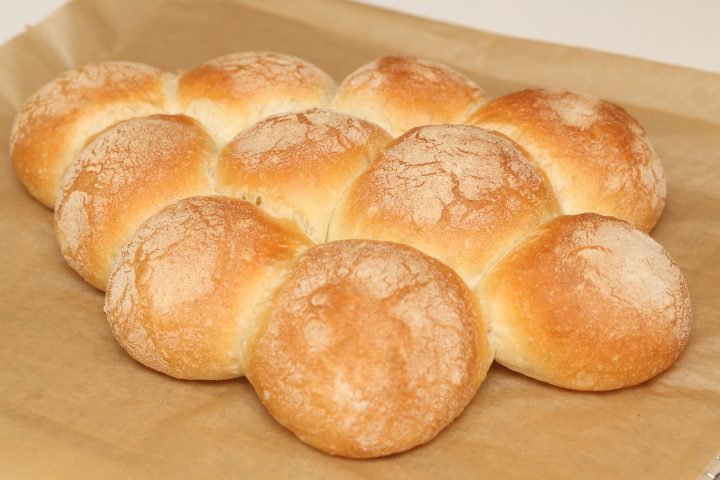
Happy Holiday baking fun, for us will always go hand in hand with aiming for great taste and texture!
This Christmas tree version of the pull-apart or break bread is an easy and fun variation on the theme we also showed with the Festive Pull-Apart Buns recipe. The recipe is straightforward and can, including the short time preferment, be completed in one morning or afternoon. This bread goes with everything else that you want to present at the Christmas table.
You can easily double this recipe to make two trees, but you will probably not be able to fit two of them in your household oven. Because the baking time is so short, it would, on the other hand, be alright to let the second batch proof just a bit longer in a cool place, before baking this second tree.
*Happy Baking & Sharing*
Ingredients for the preferment
100 g bread flour (12 to 13% protein content)
100 g water
0.7 g instant yeast = a quarter (1/4) teaspoon
Ingredients for the final dough
10 buns to form a Christmas Tree
The preferment of step 1
150 g bread flour
4 g salt
3 g instant yeast
35 g water, hand warm
25 g egg (halve an egg)
10 g honey or other syrup of choice
15 g soft butter or 12 g olive oil or vegetable oil
Optional: pinch Vitamin C, finely powdered with pestle and mortar*
Ingredients for the topping
2 tablespoons coarse semolina flour
Milk or water to moisten the tops of the buns
Baking tools: Standing mixer (or knead by hand), dough cutter, spatula, bowl, digital thermometer, timer, baking sheet (ca. 30 x 40 cm / 12 x 17.5 inches) covered with baking paper.
Weigh all ingredients carefully for the best result!
Vitamin C in bread baking*
Next to being a well know food supplement, vitamin C, also known as ‘ascorbic acid’ can also used in baking as a bread enhancer. So, What does it do?
Due to the properties of vitamin C, it can be used as a dough (gluten) strengthener during fermentation, helping to improve the structure of the dough.
Some flour types are sold with added vitamin C. The regular wheat and bread flour we use does not contain any vitamin C. So adding a tiny pinch to your dough can help improve your baking result. Professional bakers can buy ‘commercial grade’ ascorbic acid, but home bakers can also use crushed vitamin C tablets (it’s effectively the same stuff). The recommended amount is 0.07%. So this means that for this recipe, with 250 g of flour, you can use a vitamin C tablet and grind it to a powder. Take a small pinch of the powder and it will probably be close to the amount needed. Weighing will not be an option for most bakers, with these tiny amounts.
Stap 1: Make the preferment
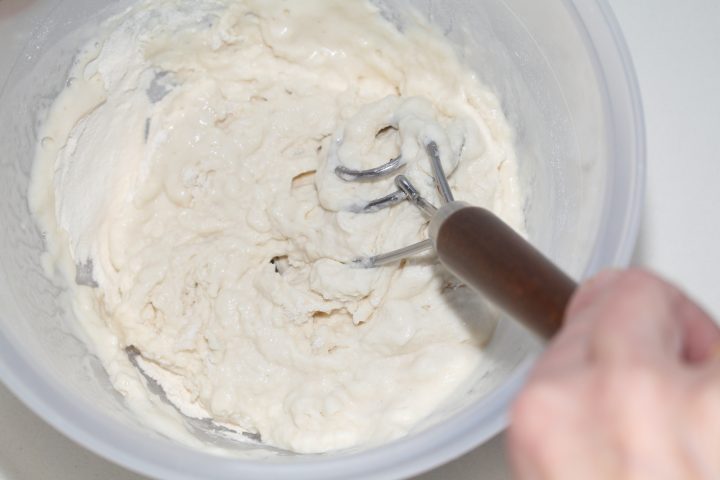
- In a bowl combine the flour, water and yeast and beat for 30 seconds until smooth. Cover the bowl and let this mixture develop for 2 hours at room temperature.
Stap 2: Make the final dough
- The the bowl of your standing mixer, combine flour, salt, instant yeast, egg, honey and butter or oil with the preferment from step 1. Add the water and start mixing (reserve a little if necessary and watch the dough come together, then add as needed.
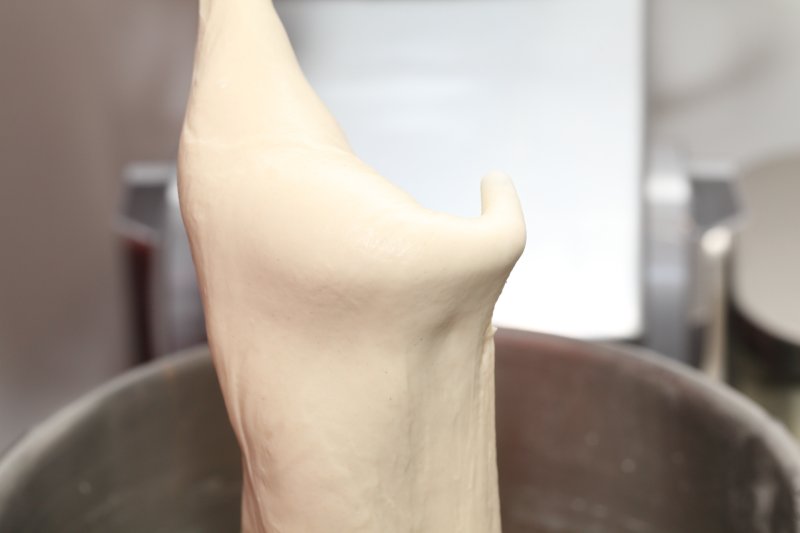
Knead the dough on medium speed for 9 minutes until you can pull a ‘windowpane’ from it (at least 15 minutes by hand). Ideally, it will come off the sides of your bowl but still stick to the bottom. Another indication to look out for is that the dough will start to shine nicely at the end of the kneading time. When you’re done, the dough should still feel a little sticky.
- Cover the bowl and leave to rest for 60 minutes
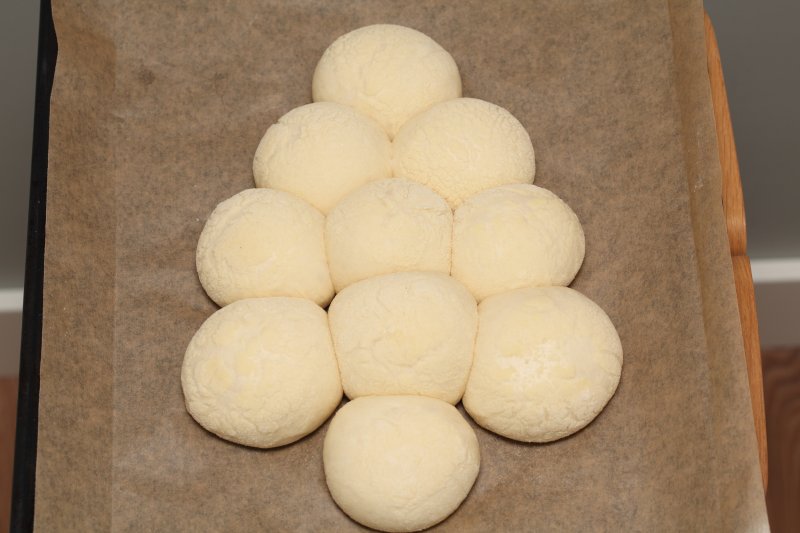
- To get the visual effect of a tree, you need to make 7 buns of 40 grams each and three larger ones of 54 gram each. Use a scale to get equal pieces of dough. Form into balls.
You can very lightly dust your work surface with flour if necessary, but don’t use too much or it will be very difficult to form the balls properly. We don’t use flour at all when forming these rolls.
- Let rest for 10 minutes (time starts when the first ball is formed).
- Carefully flatten the balls with your hand and form them into smooth balls again.
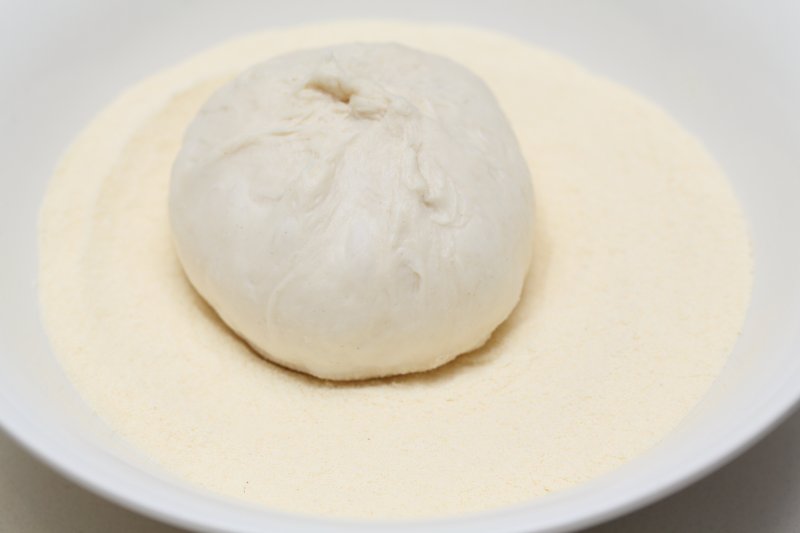
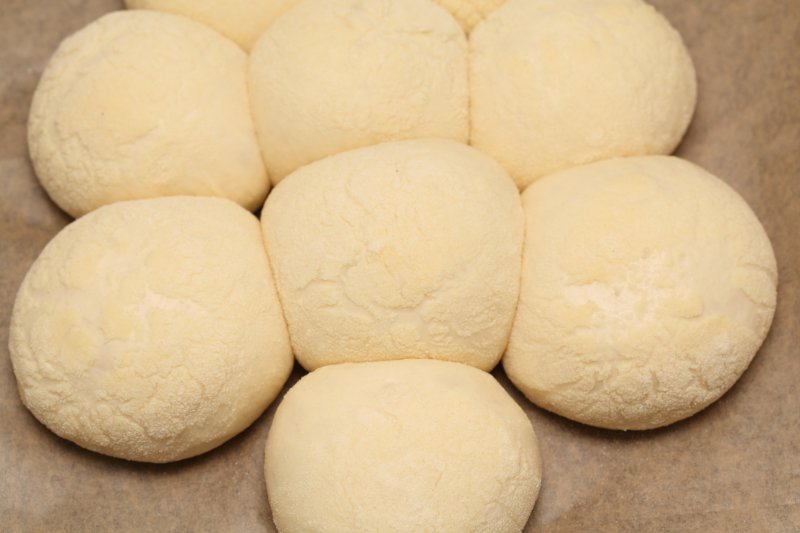
- Moisten the top of the first ball with some milk or water and dip it in the semolina flour. Place this ball on the baking tray covered with baking paper, as the base of the tree, .
- Continue with the three larger balls. Leave a bit of space between the balls, because they are going to grow with proofing. Place these as the next layer above the first ball. Continue with three smaller balls, followed by two smaller balls and finish with one small ball on top, so 10 balls in total.
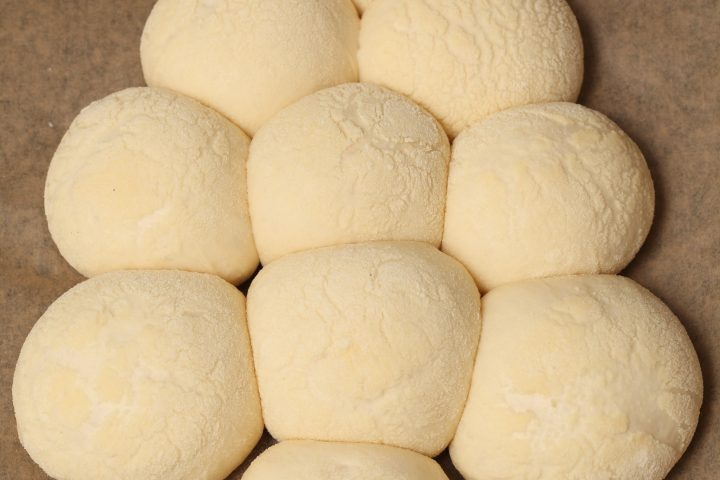
- Leave to proof for approximately 2 hours at a temperature of 25 tot 27 ºC / 77 to 80 ºF.
In a bake at home situation we use our minimally preheated and switched off oven for proofing. We measure the temperature of the inside of the oven and the dough with an infrared thermometer and aim for a temperature of 25 to 27 ºC (77 to 80 ºF). Make sure it doesn’t get too warm, because above 35 ºC / 95 ºF the yeast is effectively dormant or dead.When you think the dough has risen enough, use your finger to carefully make a small dent in a bun. If the dent remains, the bread is ready to bake, if the indentation disappears, the dough needs more time. Give it another 10 minutes, then check again
- Preheat the oven to 195 ºC / 385 ºF conventional oven setting in the final stage of the rising process. At what point exactly depends on the heating time of your oven. If you used your oven as a proofing cabinet, you should of course take the bread out of the oven first.
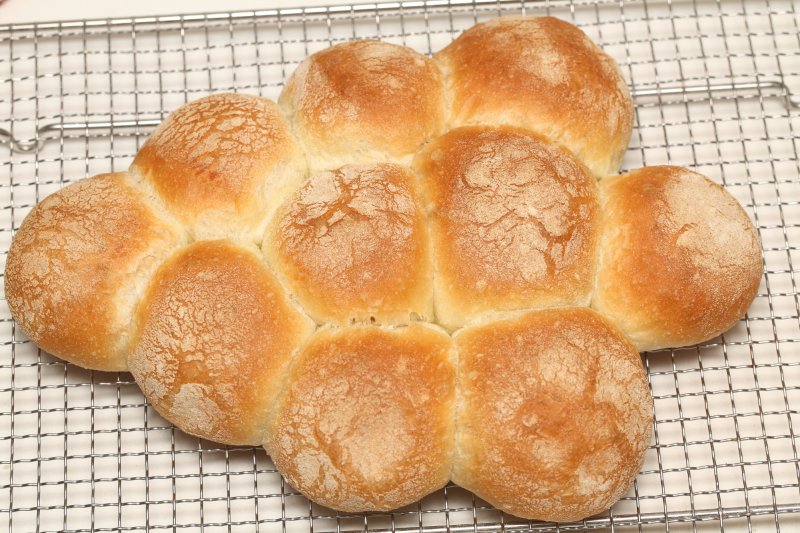
- Bake the bun-tree for about 17-18 minutes until lightly golden brown. If it has the desired color, around 2/3 of the baking process, you can temper the oven to 165 ºC / 330 ºF until the end of the baking process.
- Remove from the oven and let cool. If you are not going to serve your tree yet, it is best to put it in a bag while still a bit lukewarm to prevent the bread from drying out.
- Freezing the bread or leftover buns also works very well. And even after a round in the microwave, it is as good as fresh again, so making it in advance is no problem at all!